
The Irish Traditional Music Archive (ITMA) is committed to providing free, universal access to the rich cultural tradition of Irish music, song and dance. If you’re able, we’d love for you to consider a donation. Any level of support will help us preserve and grow this tradition for future generations.
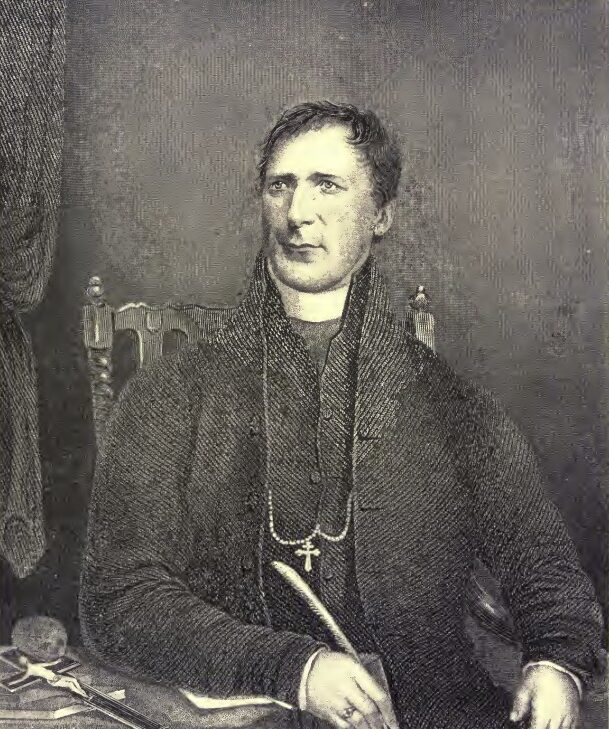
John MacHale (1789/1791–1881), Archbishop of Tuam and his Irish translation of Moore’s Melodies 1879.
John MacHale (1789/1791–1881) is widely remembered as one of Ireland’s most celebrated Archbishops. He was an outspoken advocate for Irish Catholic emancipation, as well as a vocal critic of British rule in Ireland. His high status as Archbishop of Tuam within the Catholic Church provided him with a powerful public platform, allowing him to wield influence not only in his archdiocese, but across the country. Apart from his religious and political influence, he also played a significant role in the promotion and preservation of the Irish language through translations including an Irish language translation of Thomas Moore’s Melodies first published in 1842.
Born in Mayo in the late eighteenth century, MacHale grew up in a bilingual family and was encouraged by his grandmother to keep up his studies of the Irish language. He was a strong student, whose education played an important influence throughout his life. He was first educated in a local hedge school specialising in Irish history and later went on to study Latin, Greek, and English grammar in Castlebar. His aptitude for languages caught the attention of the French priests lecturers whilst he was studying at Maynooth under scholarship who then took him in under their guidance. Notably, he was one of the first Irish Bishops since the Reformation to have been educated entirely in Ireland.
Following his studies, he spent time lecturing in theology at Maynooth before his eventual appointment as Archbishop of Tuam in 1834. He quickly gained a national reputation for his advocacy for the use of Irish within the Church, and even preached in the language on Sundays, a move that was highly unusual at the time. MacHale’s use of Irish allowed him to connect more directly with his Irish audiences, most of whom only spoke Irish and strengthen his position as a respected spokesperson for his community. He believed the language was a vital part of national identity and aimed to promote the use of it in both every day and religious life, including his own translations of many Biblical passages into Irish for his audiences. One of his most notable works was his translation of Moore’s Irish Melodies into Irish. A digitised scan of MacHale’s 1879 edition of this work can be found at the bottom of the page. For more information on MacHale’s translations of Moore’s work please see blog post Even Moore Irish: John MacHale’s translations of Thomas Moore’s Irish Melodies by Ferdia Ó Cairbre for more information.
During his time as a lecturer and later as Archbishop, MacHale was very politically outspoken. He supported tenant and workers’ rights including calling out the unfair tithes that Irish farmers were made to pay to Protestant landlords, denounced mix-faith schools believing this to be an attempt to weaken the Catholic faith and advocated for Irish self-determination. During the Great Famine, he appealed directly to America and Europe for aid and was personally involved in the distribution of the received aid amongst his parish. His strong criticism of British rule, along with his alignment with Daniel O’Connell as well as the Fenians concerned British authorities so much that they appealed directly to Rome to block his appointment as Archbishop of Tuam which ultimately failed. His advocacy eventually earned him the nickname ‘The Lion of the West’.
MacHale died on the 7th of November aged 90 or 92. A poem titled Ballad on the Death of Archbishop John MacHale [anon] describes the sorrow the town of Tuam felt on the day of his passing, and the great love and admiration the people there had for him:
This section of the poem is only a small reflection of the wider love and admiration the people of Ireland held for John MacHale, marking him as an important and influential figure in both political, ecclesiastical and cultural life in 18th century Ireland.
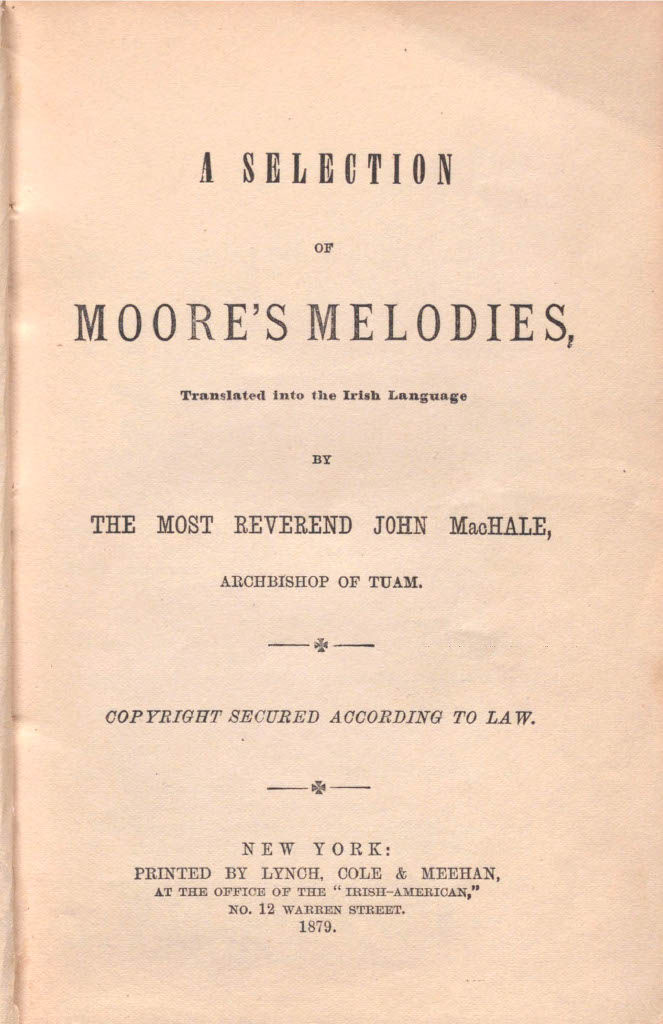
A Selection of Moore’s Melodies translated into the Irish Language by the most Reverend John MacHale. Archbishop of Tuam, 1879.
This edition of MacHale’s translation is particularly interesting, as was published by Lynch, Cole & Meehan at the office of the “Irish-American” no 12. Warren Street. This shows that not only was MacHale and Moore’s work gaining a transatlantic interest and engagement with Irish cultural and literary during the 19th century, but it also highlights a demand in the market for this material to be made commercially available and accessible for American audiences.
This post was created by Heather Wallace.