
The Irish Traditional Music Archive (ITMA) is committed to providing free, universal access to the rich cultural tradition of Irish music, song and dance. If you’re able, we’d love for you to consider a donation. Any level of support will help us preserve and grow this tradition for future generations.
Ferdia Ó Cairbre is studying for an MA in Contemporary Music Practices in Maynooth University and this blog was prepared as part of his course work in an ongoing collaboration between Maynooth University and ITMA.
Leagan Gaeilge le fáil tríd an rogha teanga ag barr an leathanaigh
Irish language version available, go to language option at top of page
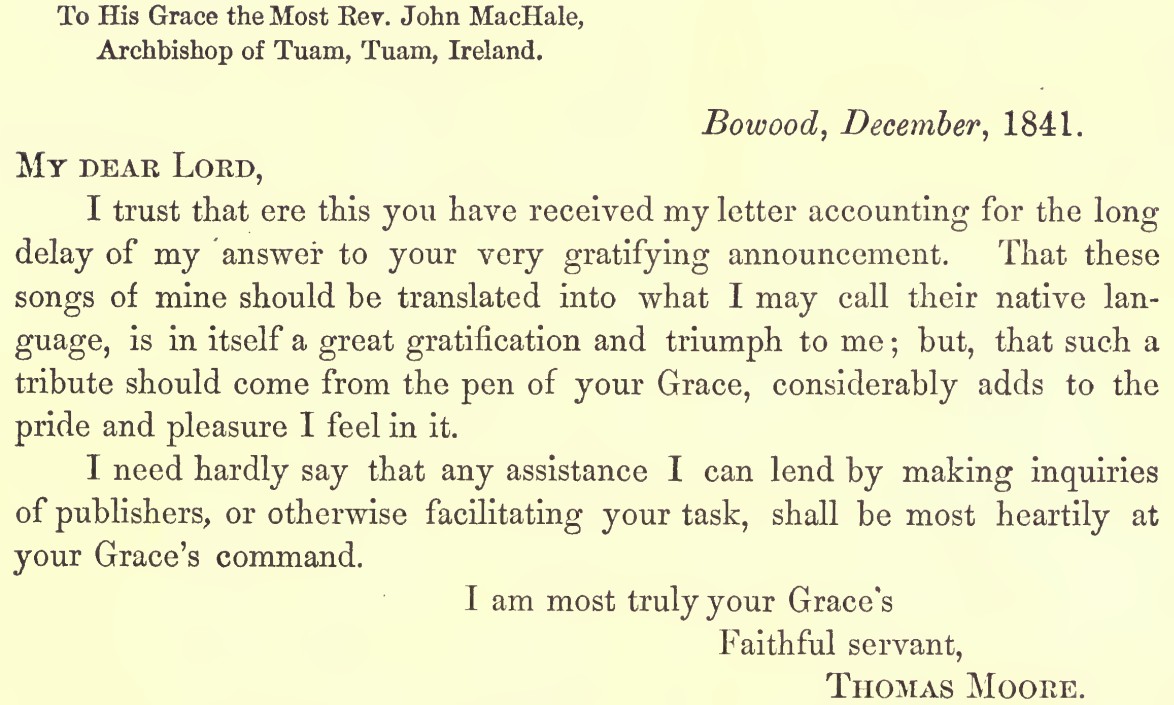
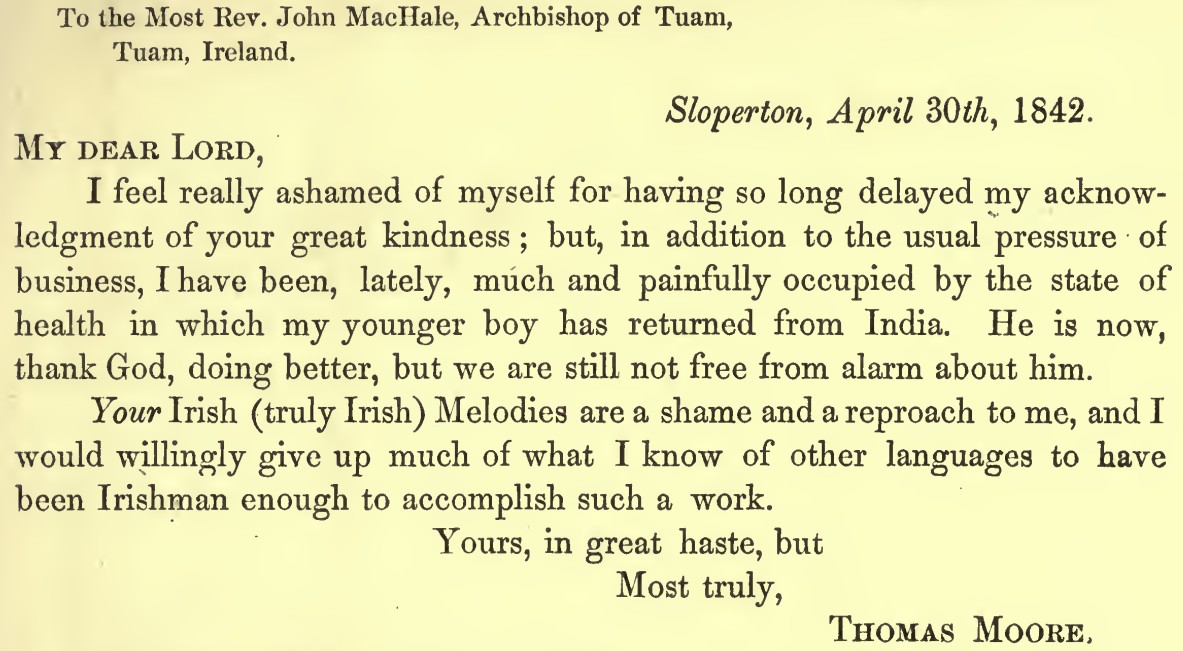
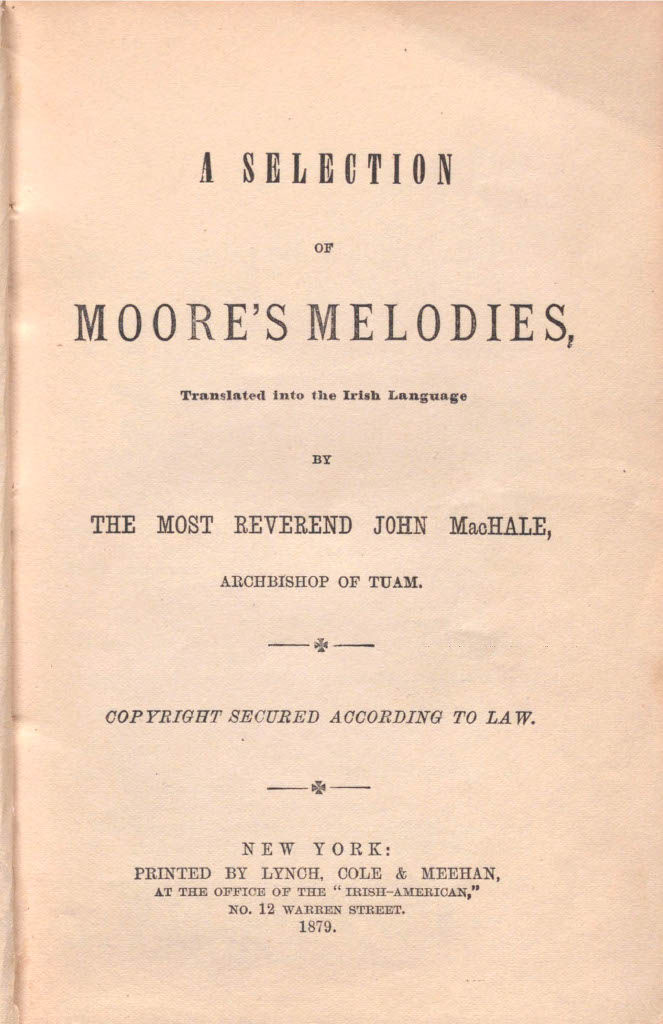
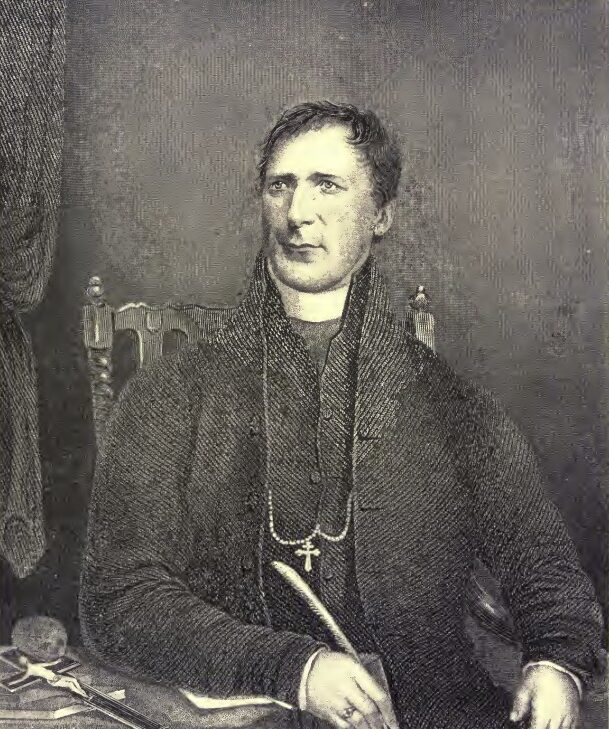
Cited as having “personified the life of nineteenth-century Ireland”, [1] John MacHale (1791–1881), Archbishop of Tuam, not only supported nationalist aspirations by staunchly engaging with Home Rule and land rights, but also by translating theological, classical, and contemporaneous literature into Irish. Given his fondness for Thomas Moore’s Irish Melodies, MacHale translated many of Moore’s songs, whose “national tone” he sought to introduce to “humbler countrymen, robed in a manner worthy of [the Melodies’] high origin.” [2] ITMA houses seven editions of these translations, ranging from the original 1842 volume to three posthumous collections edited by Thomas O’Neill Russell. Moore greatly admired MacHale and his translations, with his published correspondence to the Archbishop revealing both his “pride” and “shame” regarding not being fluent in the language:
There are many fascinating avenues to explore with these translations, not least MacHale’s engagement with the metre of the original airs, numerous typographical errors (that Russell corrected), or the appearance of his translations in nationalist newspapers. [3] However, his semantic alterations immediately stand out; MacHale frequently changed the meanings of Moore’s already patriotic lyrics and, in doing so, more forcefully communicated Ireland’s plight under British rule.
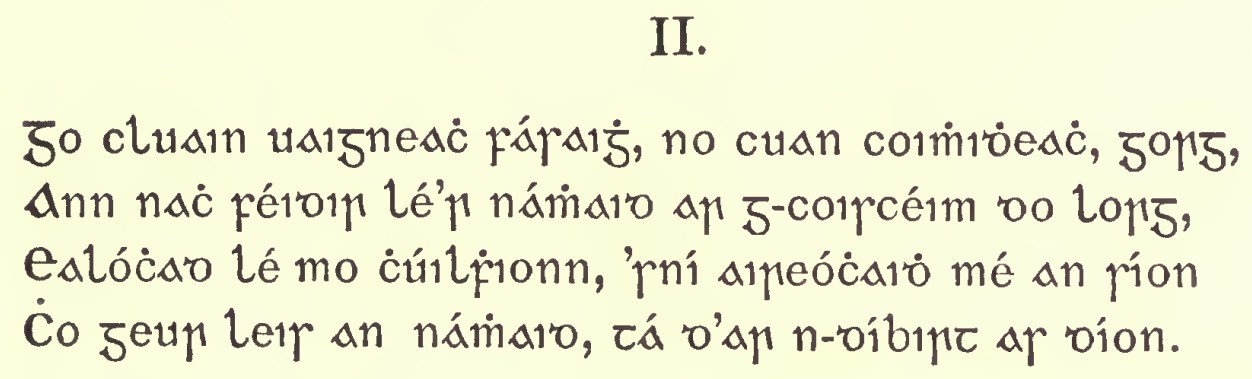
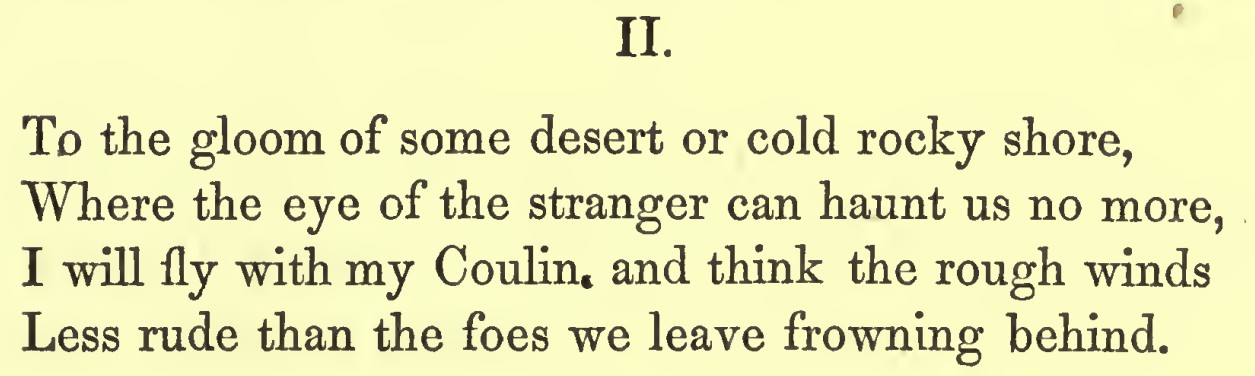
‘Gidh so m’Amharc Déigheanach ar Eirinn a Chaoidh [sic]’ (‘Though the Last Glimpse of Erin’, which is sung to the air of ‘An Chúilfhionn’), is a good example of the Archbishop taking liberties with certain words to comment on Ireland’s then-current situation.
Regarding the line, ‘Where the eye of the stranger can haunt us no more’, MacHale notably translates ‘stranger’ as ‘námhaid’ (enemy) [sic]. He bolsters this reinterpretation by framing ‘the foes we leave frowning behind’ as evictors of the Irish people: ‘an námhaid, tá d’ár n-díbirt as díon’ [sic] (the enemy, who is evicting us from shelter). MacHale therefore turns what was previously a text that touched on the narrator’s desire to escape the ‘cold-hearted Saxon’ into an explicit protest against British oppression.
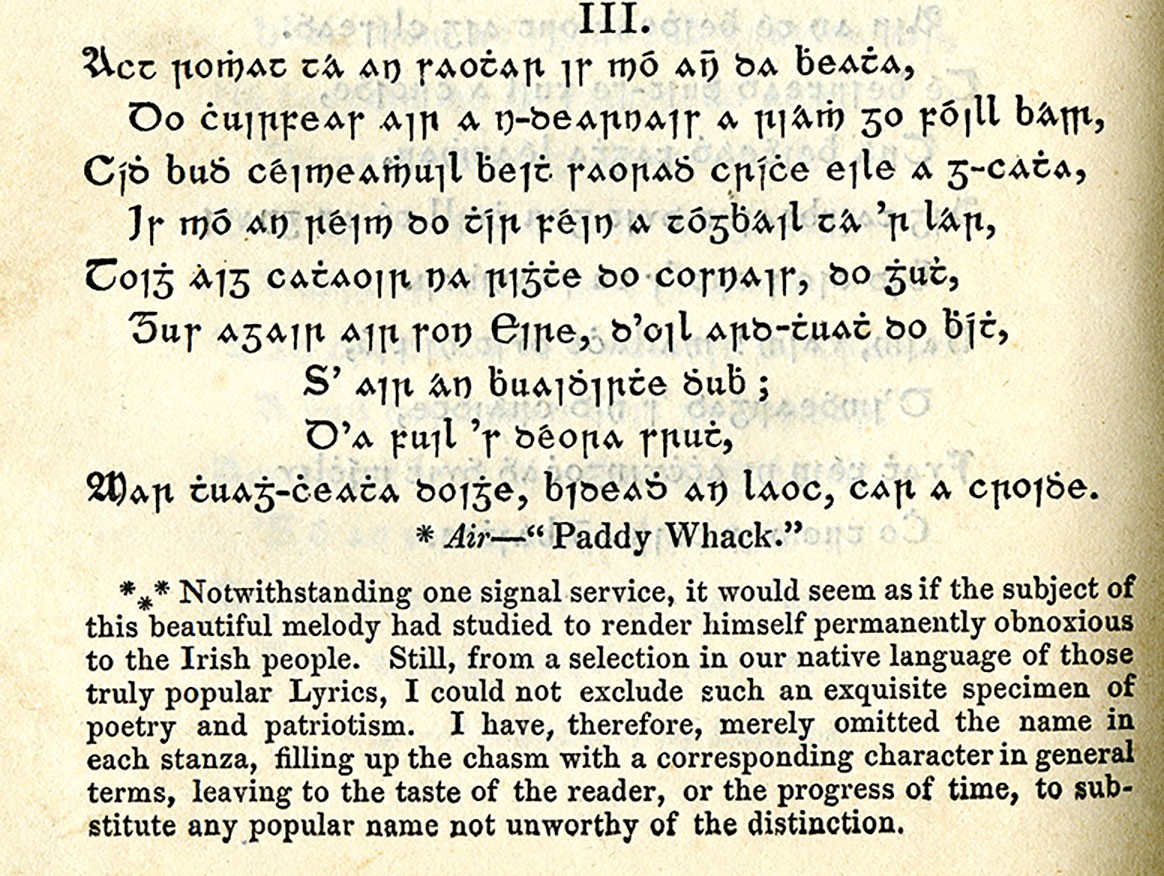
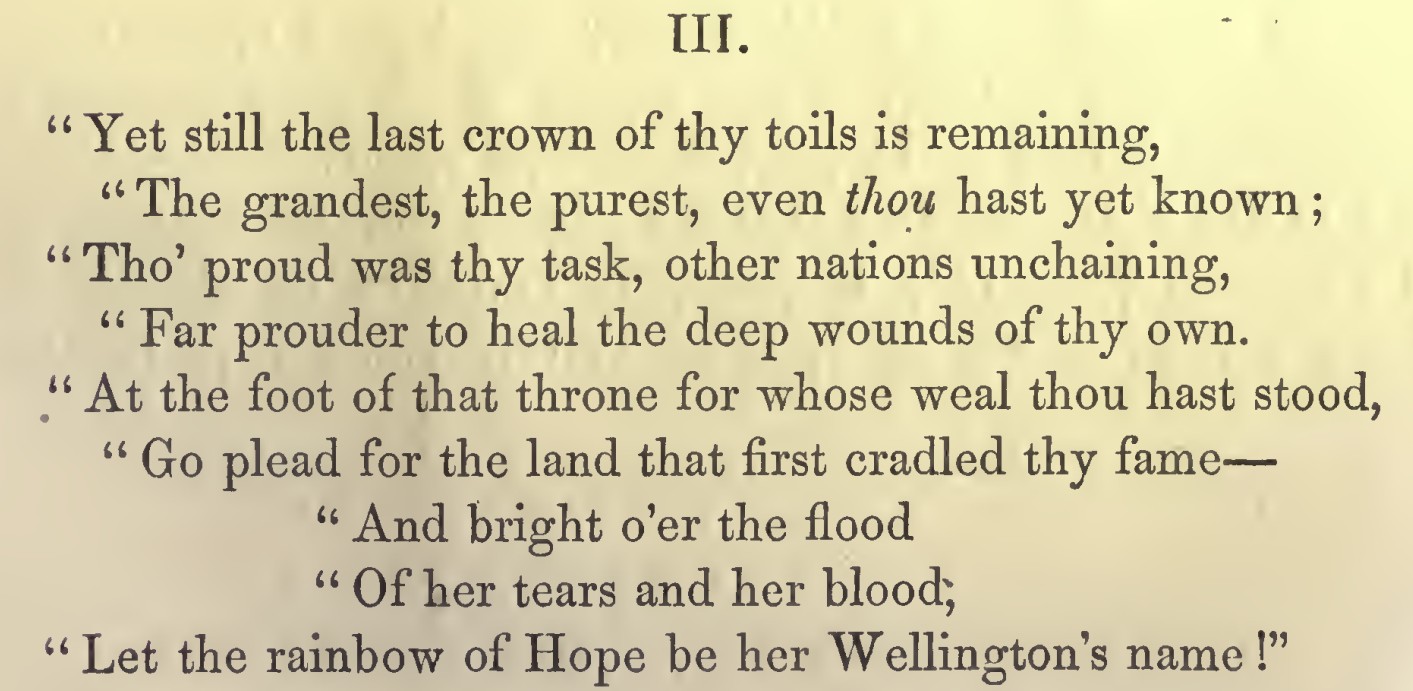
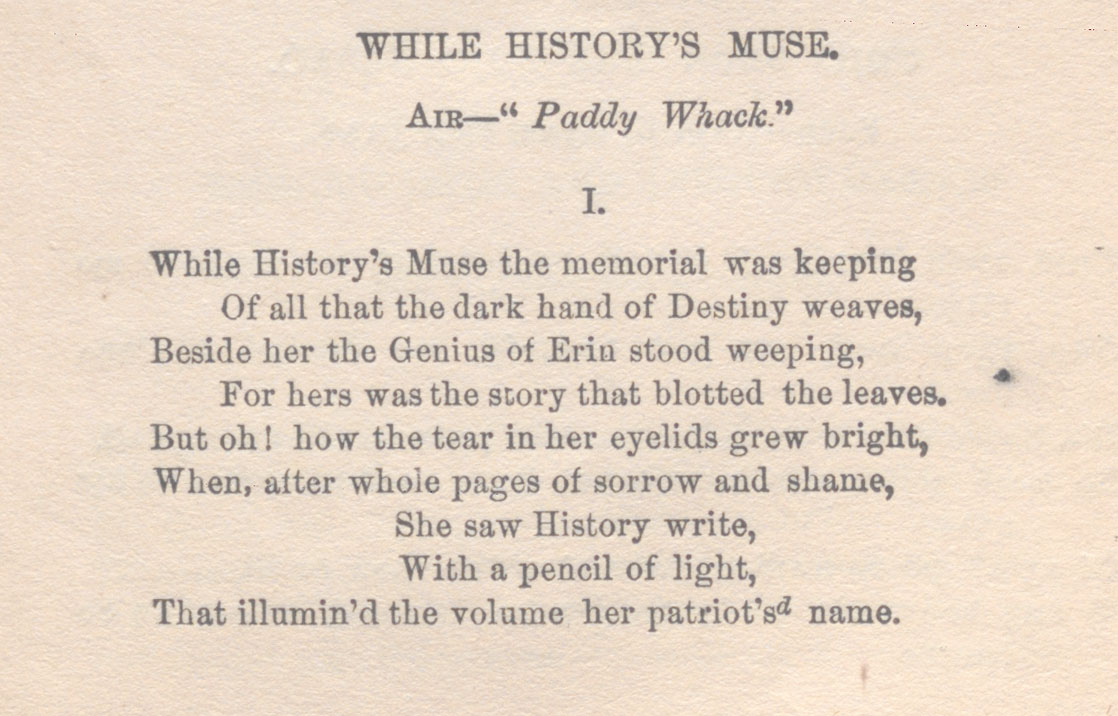
Whereas these changes are made without comment, certain others are unashamedly illustrated to readers. Moore’s ‘While History’s Muse’ positions the Irish-born British officer, the Duke of Wellington, as a potential vessel of reconciliation between Ireland and England. However, due to personal and political differences mainly involving Wellington’s opposition to Catholic emancipation, MacHale viewed him as an antagonist to Ireland. The Archbishop therefore replaced mentions of his name in Moore’s text with ‘car a croidhe [sic]’ (friend of my heart), explaining his decision in an amusing note:
The most noteworthy aspect of this translation is that, in the 1879 edition, the printing of Moore’s original English-language text was directly impacted by MacHale’s replacements. Where Wellington’s name had been printed in the 1871 version, it was now replaced by ‘patriot’, ‘cherish’d one’, and ‘hero’. This was a significant change, especially seeing as this edition was published in the United States, meaning that American readers may have interacted with Moore’s original text in an entirely unique way owing to MacHale’s distorted translation.
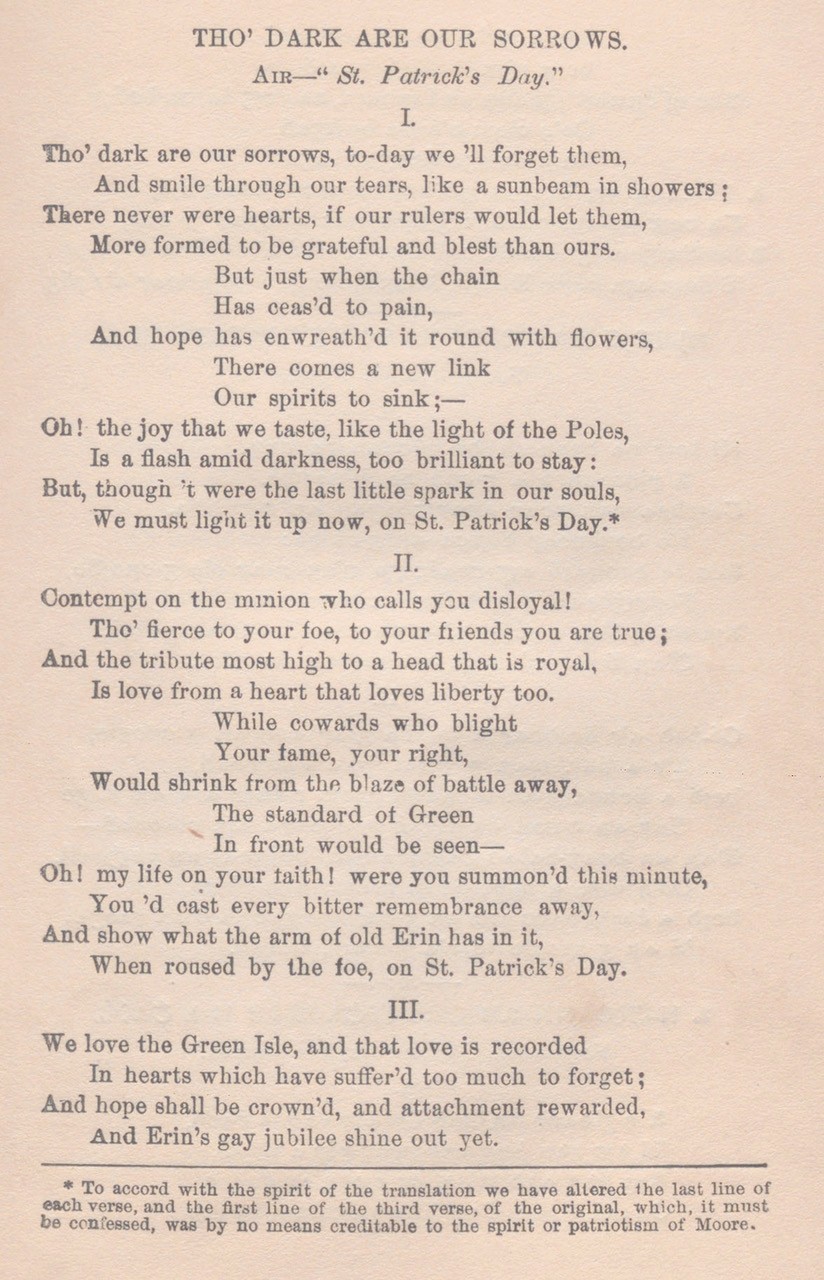
A related instance of renaming occurs in relation to Moore’s ‘The Prince’s Day’ (occasionally titled ‘Tho’ Dark Our Are Sorrows’), written for the Prince of Wales, which MacHale reframed as a celebration of St. Patrick’s Day. He accordingly altered the words ‘Prince’s Day’ in the last line of each verse to reflect this, a change which similarly had a knock-on effect on the guise of Moore’s original text. The 1879 edition therefore included a similar note to the above, with the publishers also deeming it necessary to change ‘He loves the Green Isle’ to the more rallying ‘We love the Green Isle’:
John MacHale’s translational work was therefore not too far removed from his impassioned writings and nationalist campaigns. In both his translations and the reproductions of Moore’s texts, the fusion of the Irish language with musical metre allowed for the addition of certain words that were packed with contextually meaningful and patriotic nuance.
References
[1] Hilary Andrews, The Lion of the West: A biography of John MacHale (Dublin, Veritas, 2001), p. 339.
[2] John MacHale, A Selection of Moore’s Melodies, translated into the Irish language by The Most Reverend John MacHale, Archbishop of Tuam (Dublin: James Duffy, 1871), pp. v–x.
[3] For example, see ‘Tríd Innis Fáil’, An Gaodhal, 2.11 (9 January 1883), p. 249 <https://imirce.universityofgalway.ie/p/ms/asset/103060?lang=ga> [accessed 8 April 2026].
The recordings in the above playlist were recorded in ITMA’s studio by Iarlaith Mac Gabhann. The blog post was uploaded by Heather Wallace.
Bibliography
Andrews, Hilary, The Lion of the West: A biography of John MacHale (Dublin, Veritas, 2001)
MacHale, John, A Selection of Moore’s Melodies, translated into the Irish language by The Most Reverend John MacHale, Archbishop of Tuam (Dublin: James Duffy, 1871)
MacHale, John, A Selection of Moore’s Melodies, translated into the Irish language by the Most Reverend John MacHale, Archbishop of Tuam (New York: Lynch, Cole & Meehan, 1879)
MacHale, John, A Selection of Moore’s Melodies, translated into the Irish language by the Most Reverend John MacHale, Archbishop of Tuam (New York: Lynch, Cole & Meehan, 1880)
MacHale, John, A Selection of the Most National and Popular of Moore’s Melodies with Translation in Irish by The Late Most Rev. John MacHale, Archbishop of Tuam, ed. by T. O. Russell (Dublin: M. H. Gill & Son, 1899)
MacHale, John, A Selection of the Most National and Popular of Moore’s Melodies with Translation in Irish by The Late Most Rev. John MacHale, Archbishop of Tuam, 2nd edn, ed. by T. O. Russell (Dublin: M. H. Gill & Son, 1901)
MacHale, John, A Selection of the Most National and Popular of Moore’s Melodies with Translation in Irish by The Late Most Rev. John MacHale, Archbishop of Tuam, 3rd edn, ed. by T. O. Russell (Dublin: M. H. Gill & Son, 1903)
MacHale, John, Moore’s Melodies in Irish by his Grace the Archbishop of Tuam (Dublin: John Cumming, 1842)
‘Tríd Innis Fáil’, An Gaodhal, 2.11 (9 January 1883), p. 249 <https://imirce.universityofgalway.ie/p/ms/asset/103060?lang=ga> [accessed 8 April 2026]