

The Irish Traditional Music Archive (ITMA) is committed to providing free, universal access to the rich cultural tradition of Irish music, song and dance. If you’re able, we’d love for you to consider a donation. Any level of support will help us preserve and grow this tradition for future generations.
Compiled by Paddy Cummins
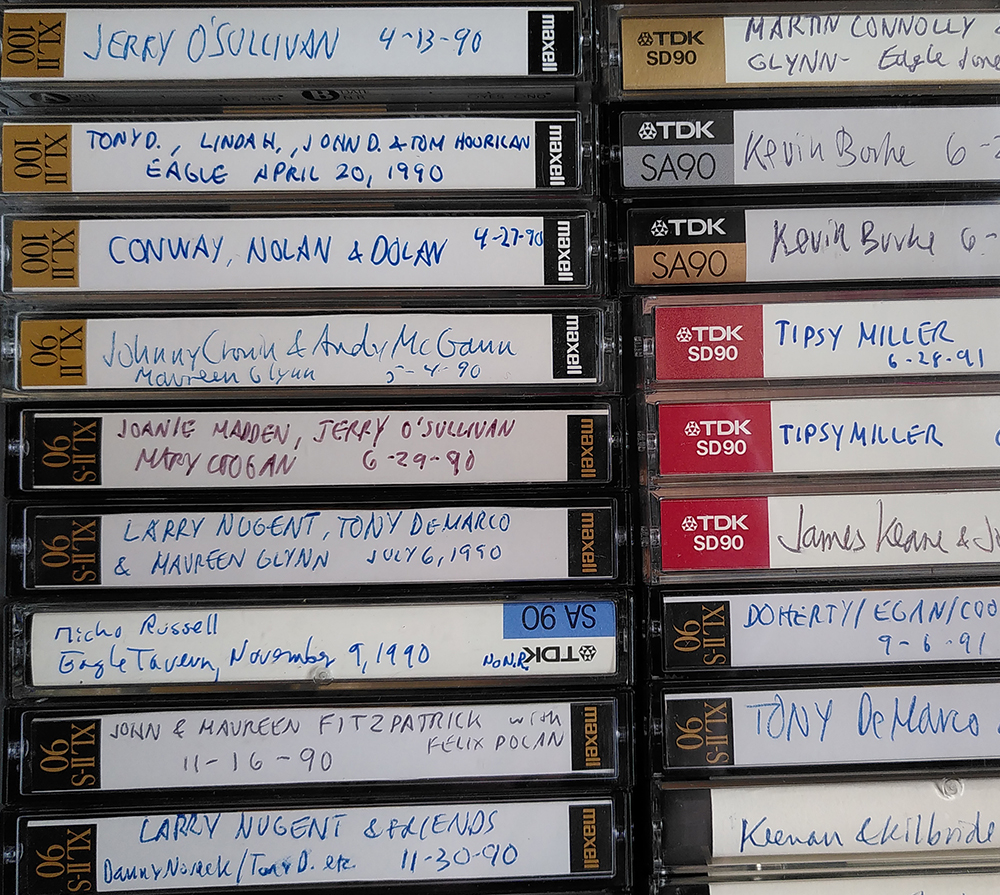
For the past few months I have been working on cataloguing the tunes found within the extensive Don Meade collection. Don ran gigs at two popular New York venues in the 1980s and 1990s – The Eagle Tavern and its successor The Blarney Star. Every week fans of Irish traditional music in the bustling city of New York could enjoy the cream of the crop performing in a raw, intimate setting and in a variety of different line-ups. Be it pure solo gigs by the likes of stars such as Kevin Burke and Liz Carroll, duets and trios from legends of the city such as Andy McGann, Paddy Reynolds, Jack Coen, and Felix Dolan or young upstarts of the day like Séamus Egan, John Doyle or Matt
Mancuso, Don gave a platform to them all to perform for a welcoming audience.
While the focus was on Irish traditional music and song some performers did buck the trend such as Cape Breton virtuosos Jerry Holland and Natalie MacMaster, Frank Woerner and his sea-shanty repertoire or bits of bluegrass, old-time and blues from versatile players like John McGann and Alex Tobias. Trawling through this collection was pure joy for me – as it tends to be with any collection – and along the way I’ve found some themes that caught my ear.
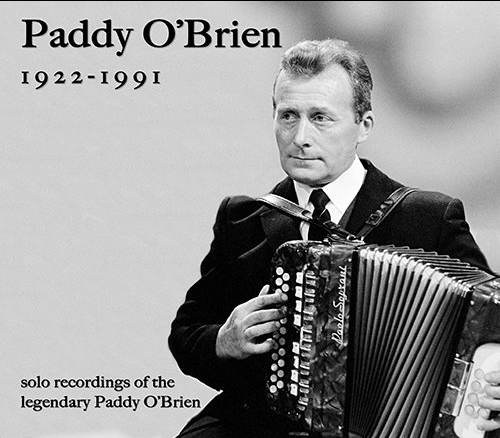
Resident in New York during the 1950s was the great Tipperary accordion-player and composer Paddy O’Brien. Having arrived there in the mid-1950s and remaining until returning home in 1962, Paddy changed the face of accordion playing in the Irish tradition with his inventive way of playing the two-row button accordion pitched in a then-contemporary B/C system. Without meaning to sideline the impact of the great George Ross of Wexford, O’Brien’s influence cannot be overstated. A melting pot of advancements in the tapestry of Irish traditional music all converged at an advantageous time. O’Brien’s move to New York City coincided with the development of the long playing record (LP) a few years previous along with growing affordability in travel between the US and Ireland. With a strong cohort of Irish emigrées in the city along with a new generation of American-born musicians with familial ties to the homeland, Paddy’s reputation exploded. Having cut his teeth with the Aughrim Slopes Céilí Band and the Tulla Céili Band before leaving Ireland, Paddy would then go on to help form the New York Céilí Band with giants of the day like Andy McGann, Jack Coen, Larry Redican and Felix Dolan.
Along with his inventive playing – a style favoured by fleadh adjudicators then and, perhaps controversially, today too – Paddy was a prolific composer and a large proportion of his tunes found their way into the general repertoire quite rapidly. So many of these are still staples today throughout the traditional music world.
Upon listening to a selection of different concerts it became clear to me that certain New York musicians leaned heavily on the repertoire of Paddy O’Brien while also paying tribute in considerable proportion to his long-standing sparring partner and relation Seán Ryan and Cavan born, Philadelphia-based composer Ed Reavy. Not least of those to pay tribute were Patrick Ourceau, Denis Galvin, Brian Conway, Martin Connolly and the aforementioned Jack Coen. In one
concert from November 1992 Galvin and Ourceau played 12 numbers attributed to O’Brien throughout the performance! Popular tunes such as Hanley’s Tweed or Larry’s Favourite were in ample supply across the collection but I’ve also managed to find quite a number of lesser-played compositions too such as The Grouse on the Hill, Liz Carroll’s take on the jig The Trip to Bantry and Wednesday Visit by Patrick Ourceau. There was a noticeable affinity for hornpipes across the collection with various examples of tunes such as Dapper’s Delight, Dan’s Request and Shrove Tuesday, as played here by Willie Kelly, Denis Igoe, Dom Rooney and Bill Black. There’s also selections from the brilliant duet of Brian Conway & John Nolan and The Irish Tradition (Billy McComiskey, Brendan Mulvihill & Andy O’Brien).
I’ll conclude by saying that, in some circles, Paddy O’Brien tunes have been called things such as “harmless” or compared as being too close to traditional tunes to be considered tunes in their own right. All I can say is – nonsense. Paddy’s tunes followed a particular trend in composing at the time which took a lot from the traditional tunes of the past while bringing them in a new direction. I like to think of them as phrased in a sort of “blocky” way. We take it for granted today but the way tunes like Ormond Sound or The New House were phrased and the notes selected were a thing apart from the older dance tunes and certainly ones associated with the piping tradition. Yet, he still held true to what is easily recognisable as that “contemporary, traditional tune”. You’d know a Paddy O’Brien tune when you hear one and it’s no surprise that New York embraced his pen as much as we did at home.