
The Irish Traditional Music Archive (ITMA) is committed to providing free, universal access to the rich cultural tradition of Irish music, song and dance. If you’re able, we’d love for you to consider a donation. Any level of support will help us preserve and grow this tradition for future generations.
Irish traditional music has been documented in various formats since the early eighteenth century, incorporating manuscripts, printed publications, and most recently, audio recordings. By comparing these sources, the evolution of tunes can be traced over this three-hundred-year period.
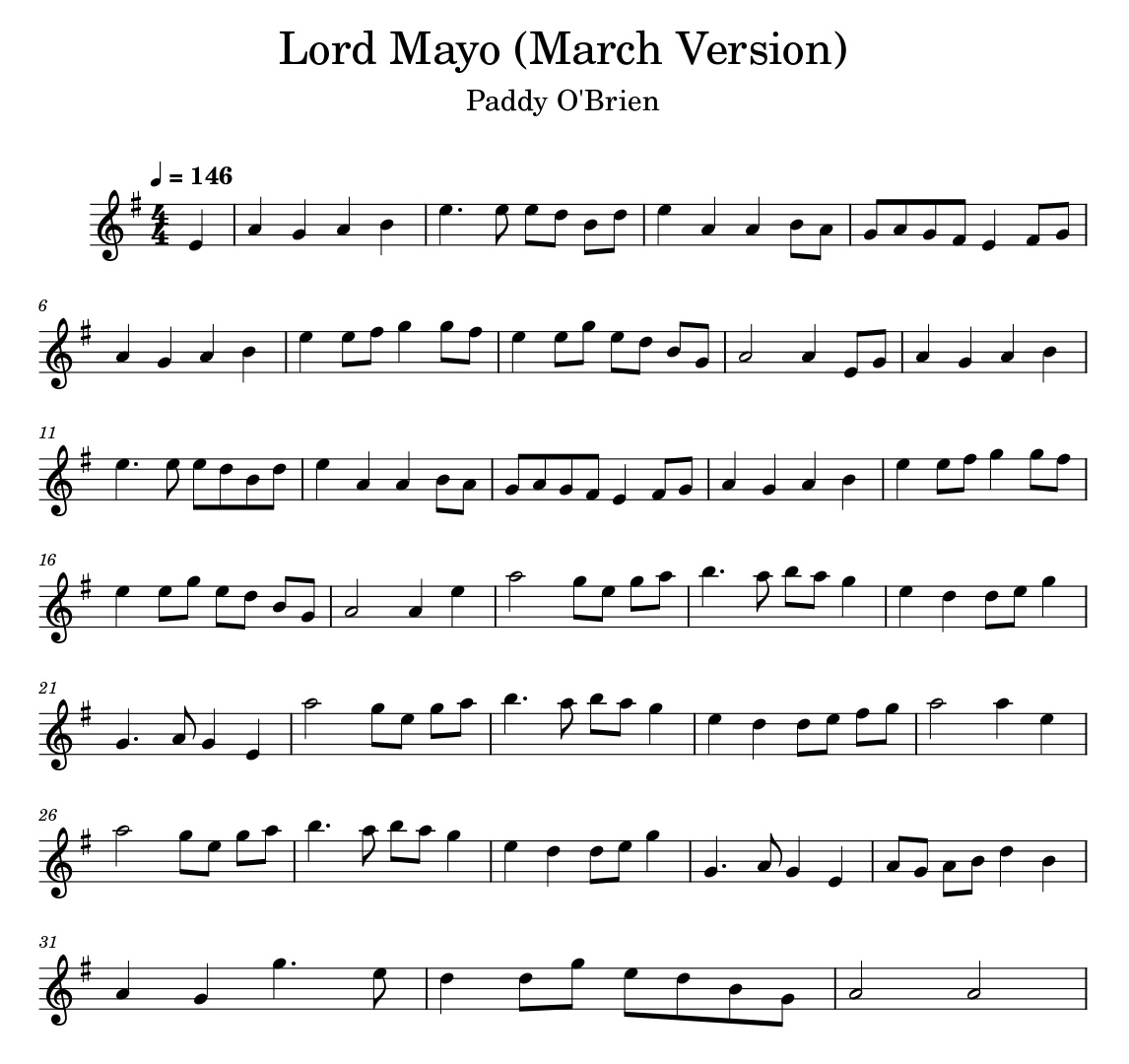
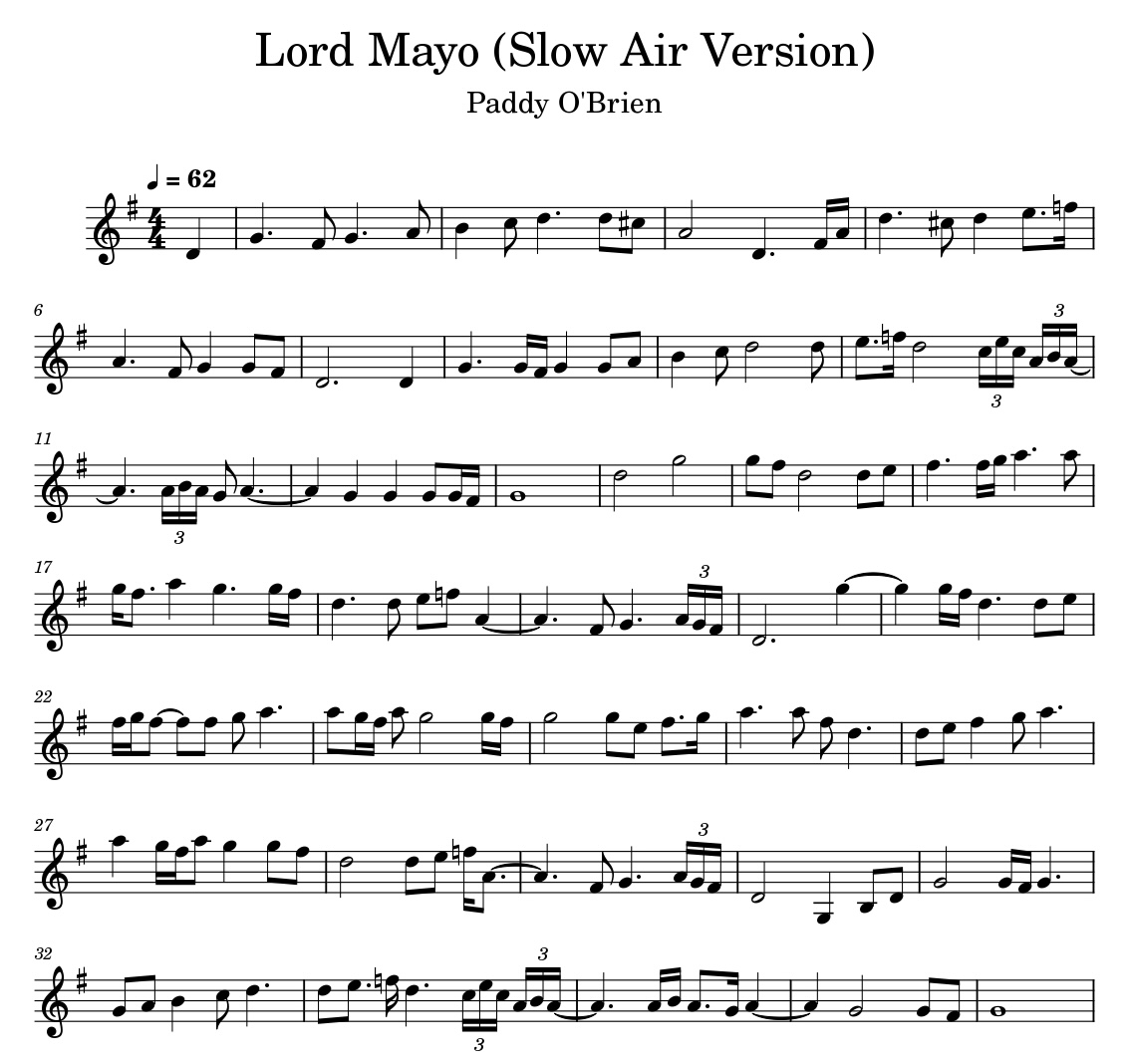
‘Lord Mayo’ has had many iterations since its first publication, eventually branching into two distinct forms—a march and a slow air. The tune is believed to have been composed by a bard of Lord Mayo, who wrote the song to regain the Lord’s favour after offending him. Although sometimes attributed to Turlough O’Carolan, multiple sources have suggested that the air is “very ancient, and [was] composed long before the time of Carolan.” [1] It is likely that ‘Lord Mayo’ was composed by either Thady Keenan or David Murphy, two early 17th century harpers, making the Lord Mayo in question the first Viscount Mayo, Theobald Burke (1567–1629). [2]
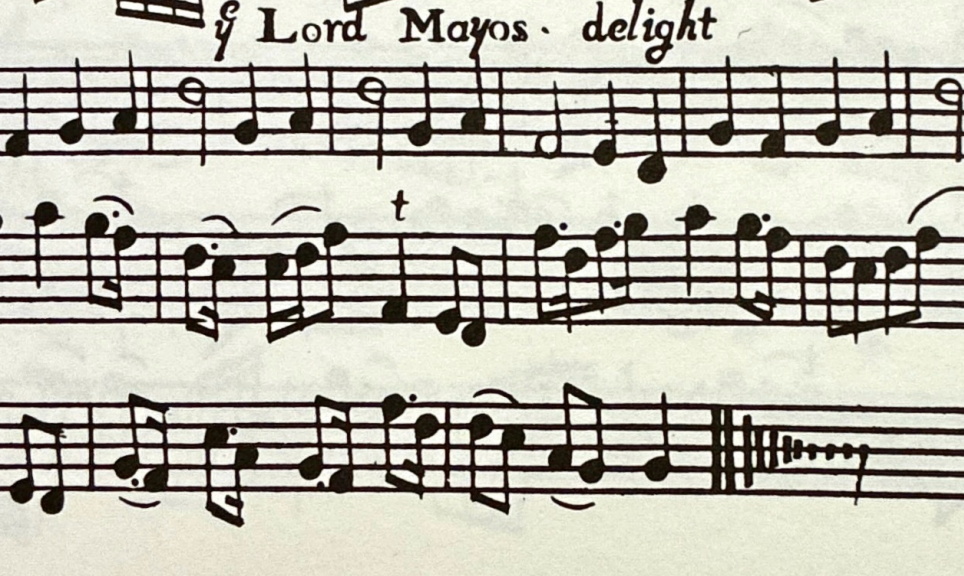
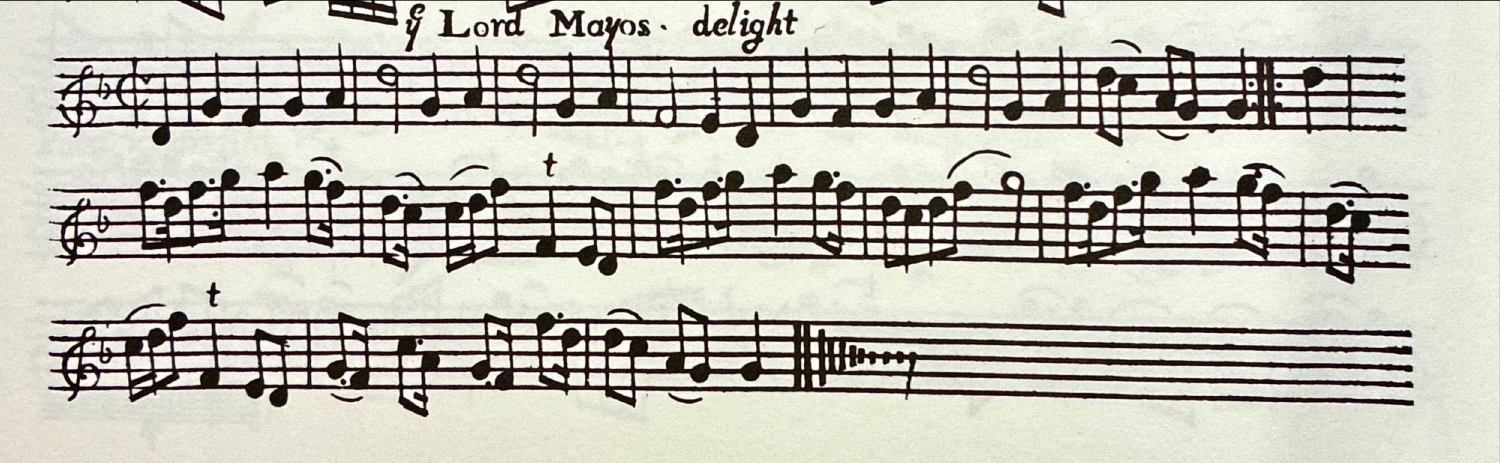
Released in Dublin in 1724, John and William Neal’s A Collection of the Most Celebrated Irish Tunes was the earliest printed collection of Irish traditional music and the first documentation of ‘Lord Mayo’. [3] It is interesting to note that the crotchet rhythm in the A part clashes with the dotted quaver movement in the B part. The doubled rhythm results in the impression of mismatched speeds and an uneven seven-bar part, going against the standard 4-/8-bar tune structure.
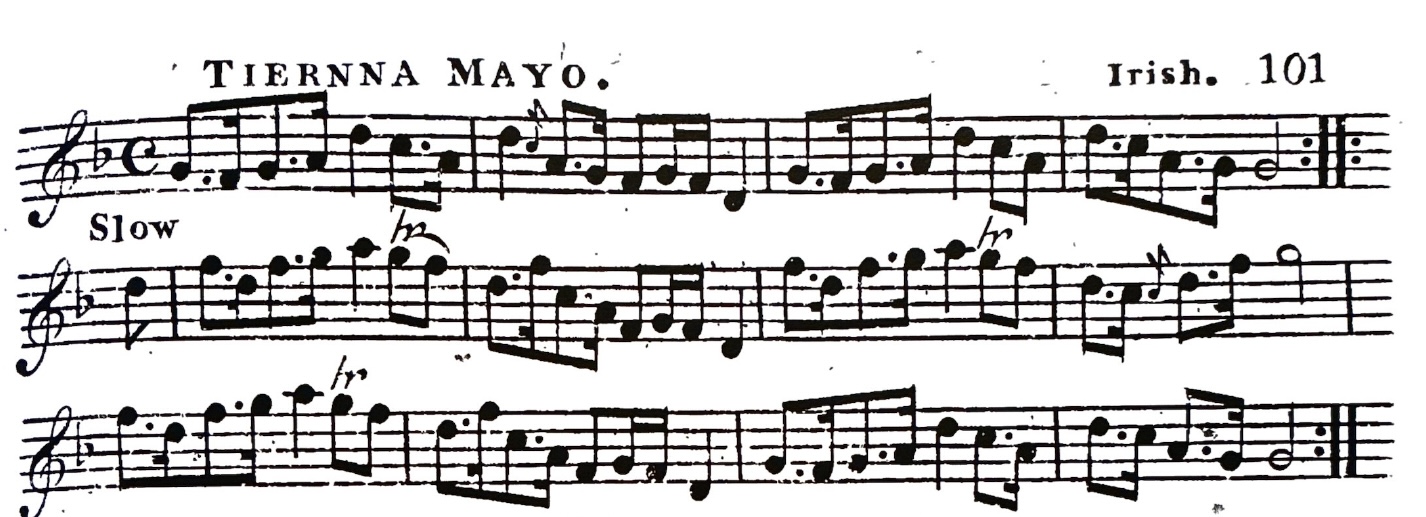
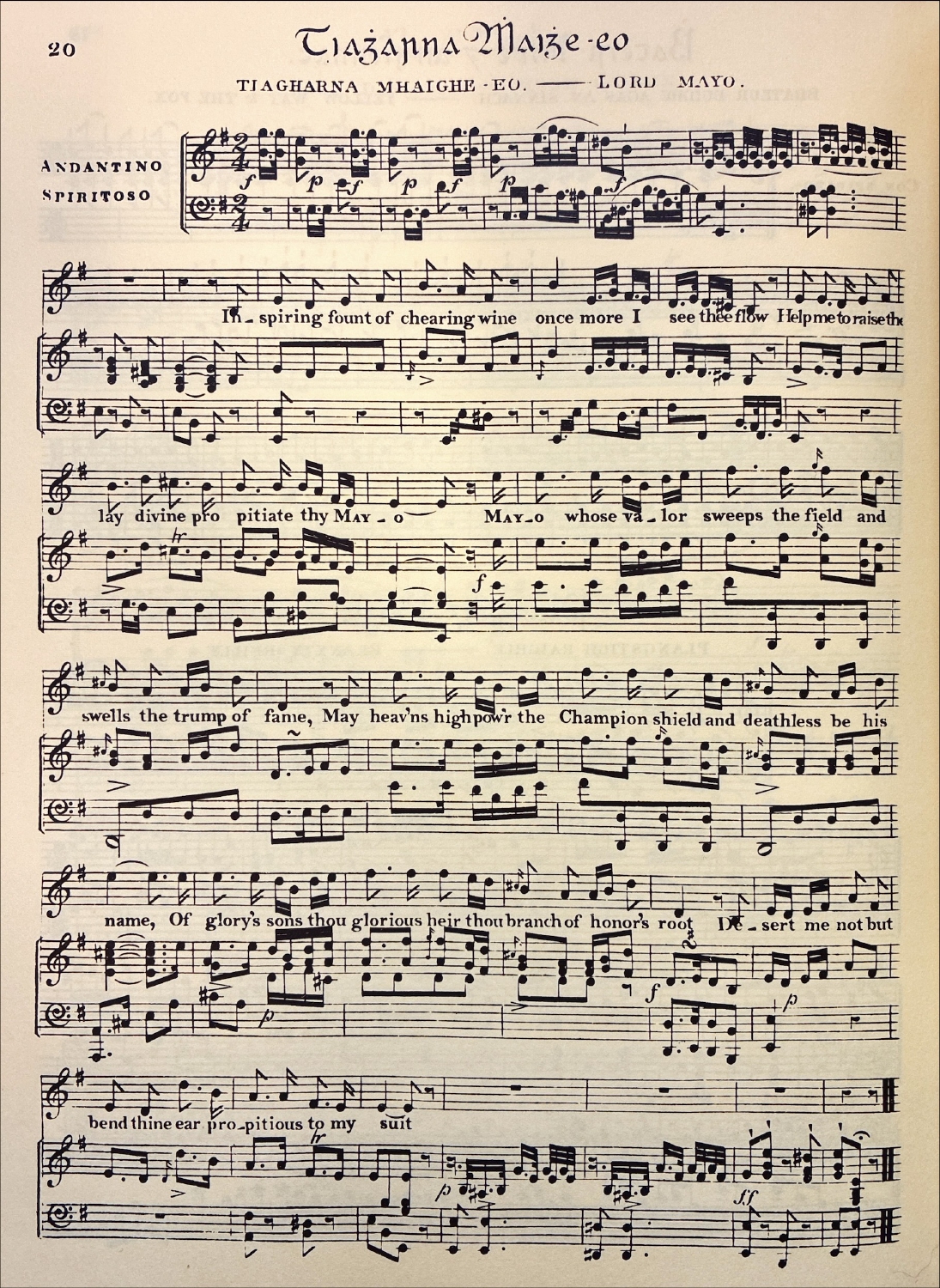
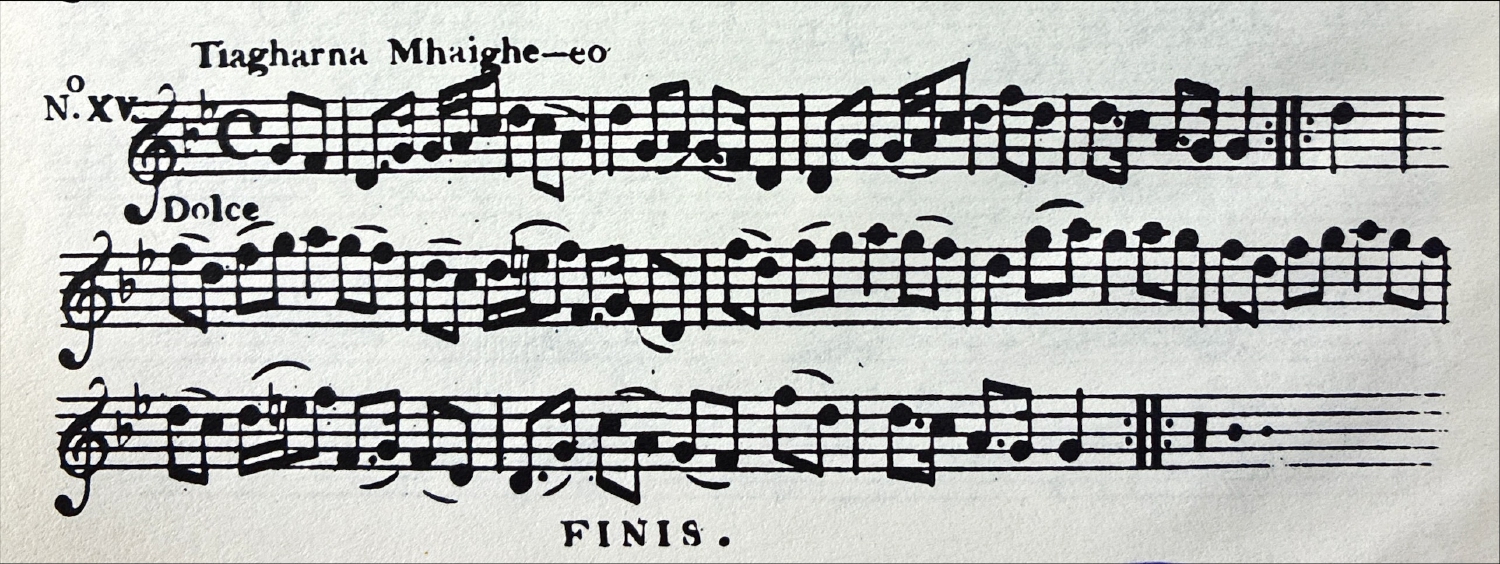
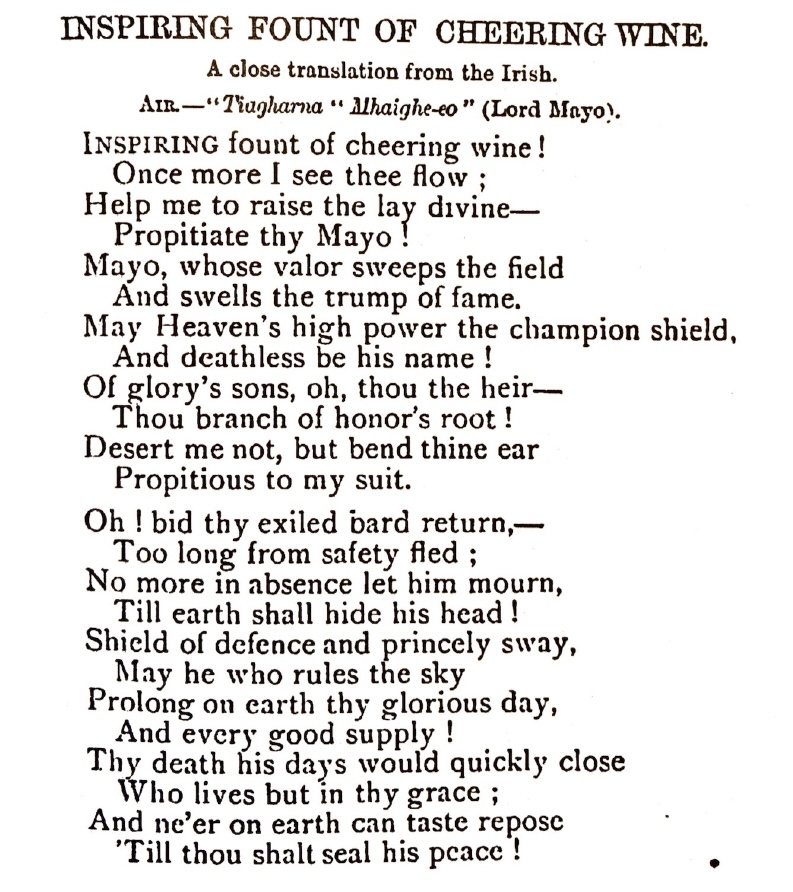
A similar, albeit more rhythmically cohesive, version of the tune appears in O’Farrell’s Pocket Companion for the Irish or Union Pipes (1806), with a dotted-quaver style throughout. Soon after, Edward Bunting included ‘Tiagharna Mhaighe-Eo’ in his famous A General Collection of the Ancient Music of Ireland (1809). This notably features English lyrics alongside the music, which he took from Joseph Cooper Walker’s Historical Memoirs of the Irish Bards (1786). While Bunting used this as his lyrical source, he appears not to have been influenced by the music included in Walker’s text. These reappeared later in the century in a New York publication, Patrick John Kenedy’s The Universal Irish Song Book (1884).
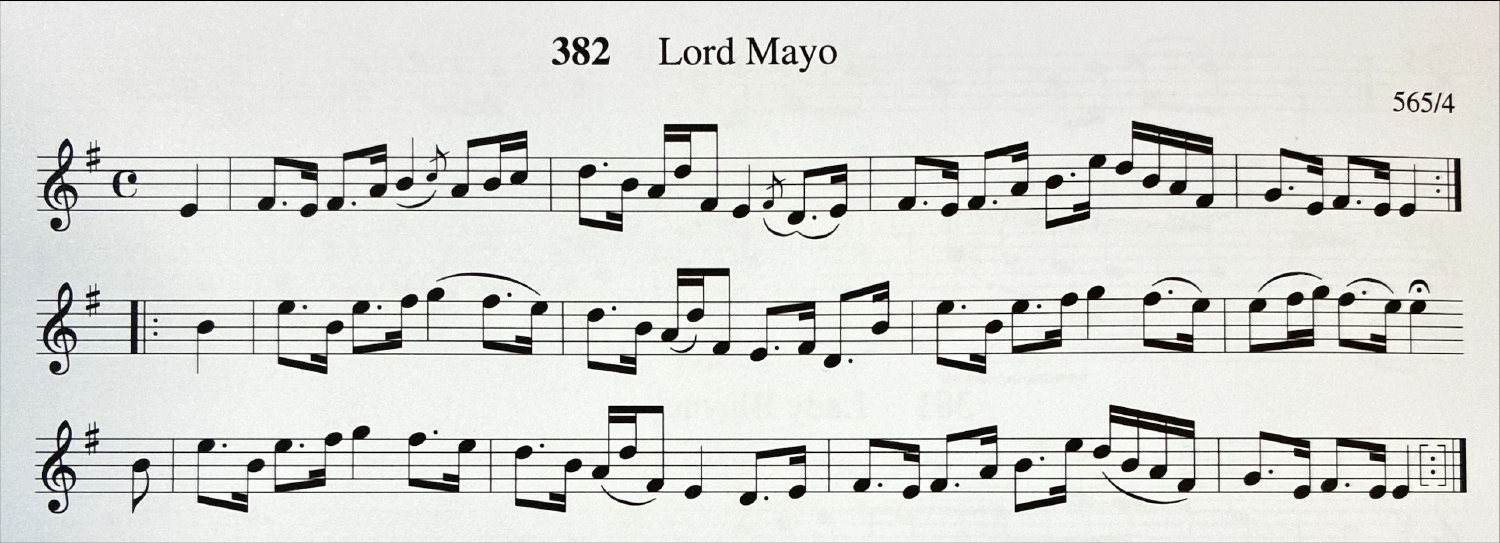
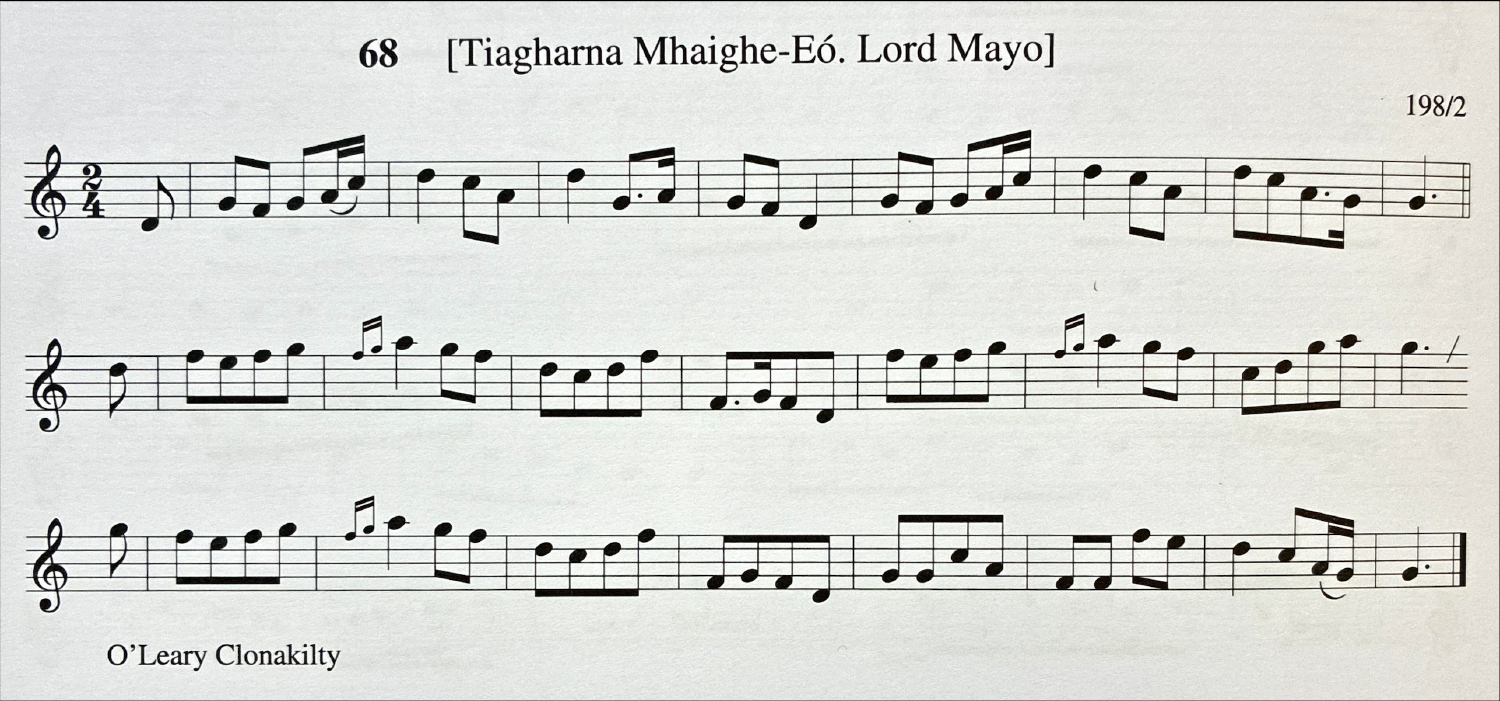
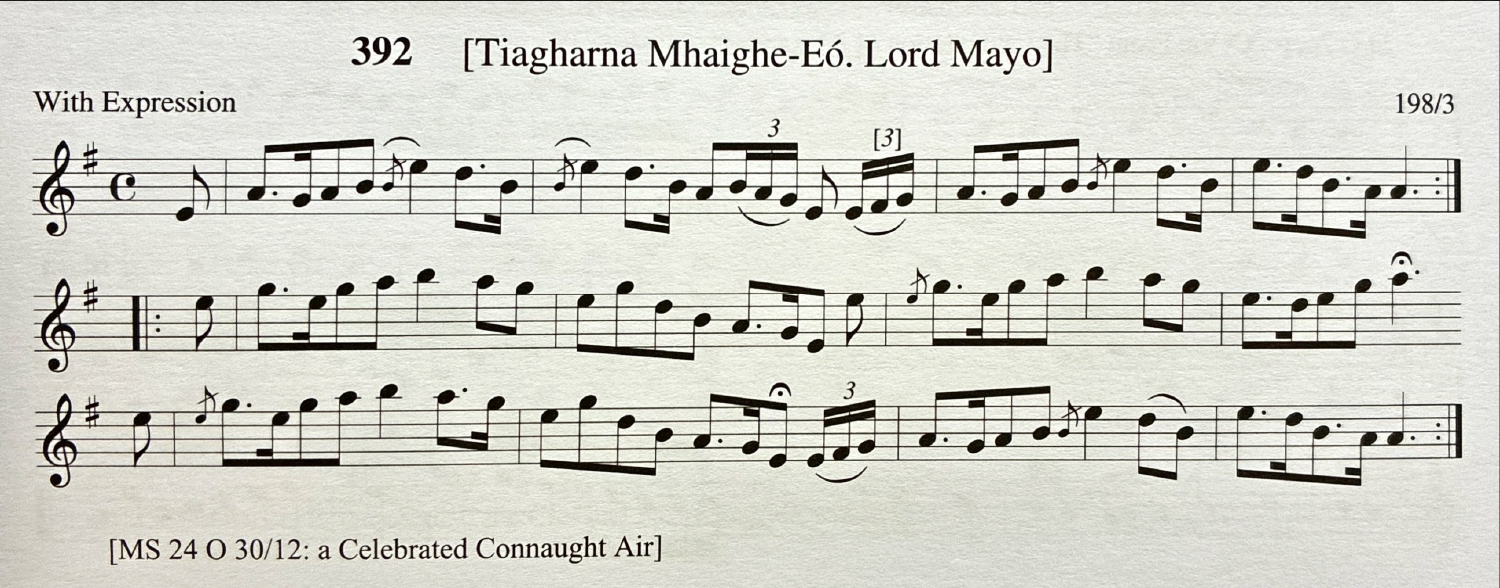
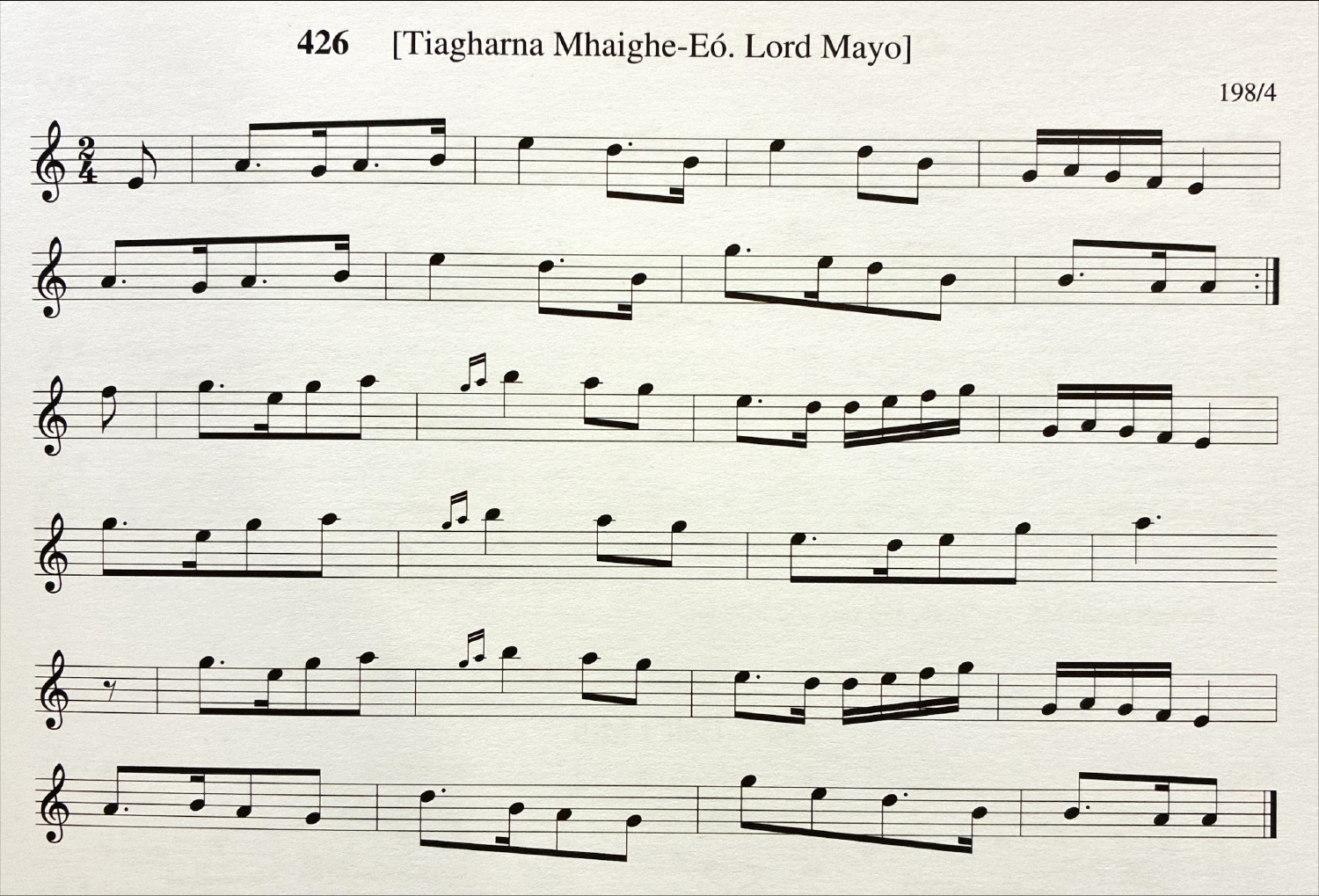
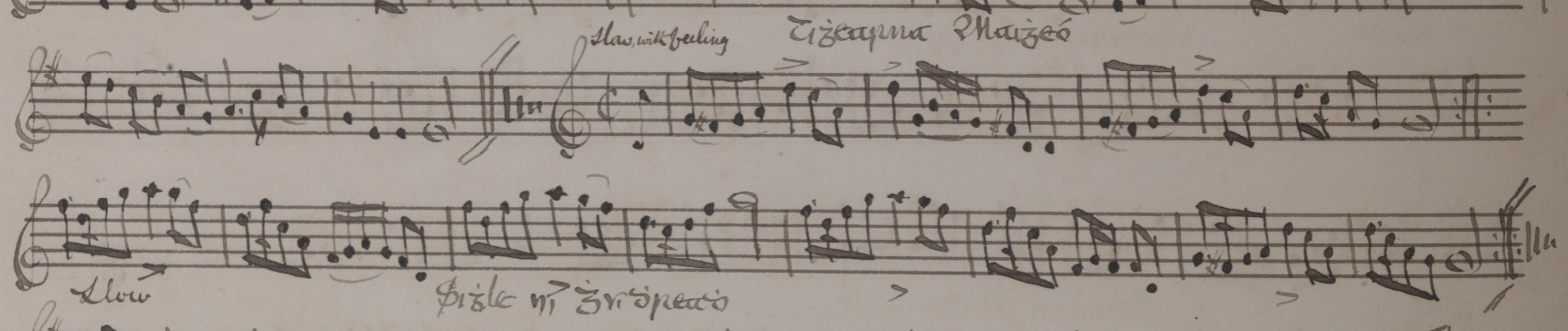
Multiple contrasting versions of ‘Lord Mayo’ appeared in 19th century collections. These versions, particularly those collected by Patrick MacDowell in London, showcase the development of the tune’s march form. It is thus possible that the tune began to branch into its two forms around this time. These versions are printed in recent ITMA publications: The Pigot Collection, The Forde Collection, and Tunes of the Munster Pipers.
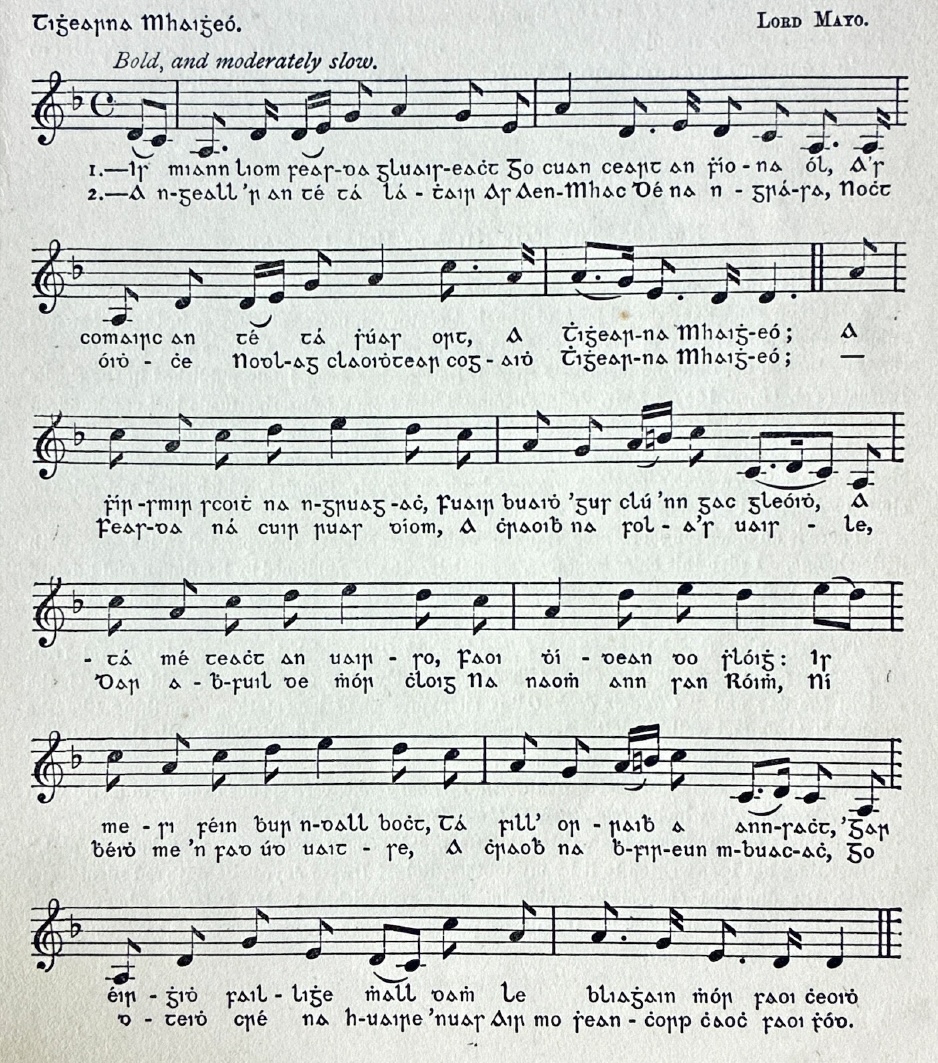
Moving into the 20th century, Irish-language lyrics of ‘Lord Mayo’ appeared alongside the music in Patrick Weston Joyce’s Irish Music and Song: a Collection of Songs in the Irish Language Set to Music (1901). Given its similarities in melodic contour and rhythm, the music may be a transposed copy of Walker’s aforementioned version.
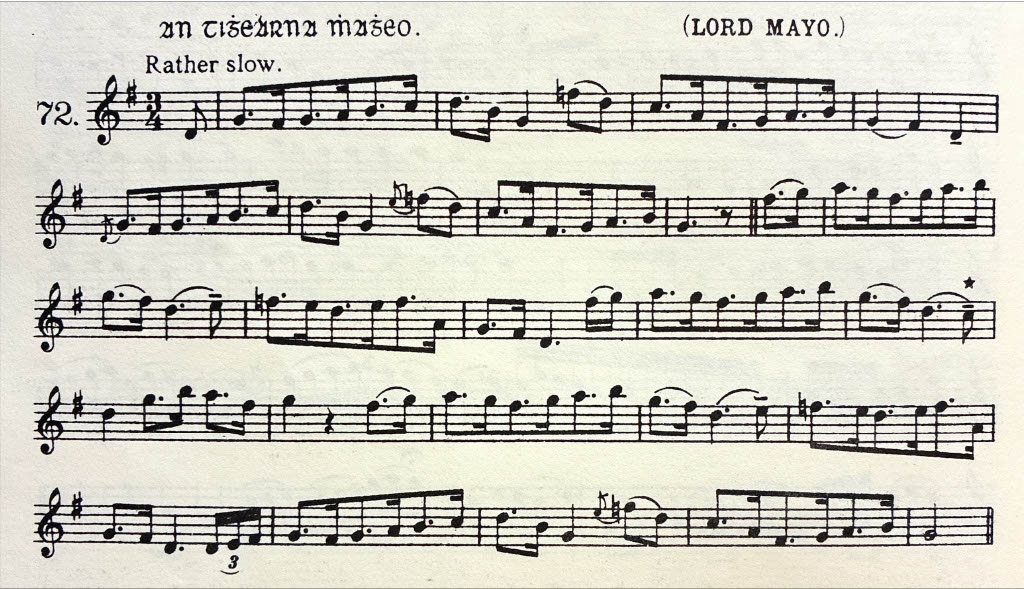
The version included in Francis Roche’s 1912 collection a decade later is the furthest-removed variation from the 1724 Neal version, with a 3/4 time signature, major tonality, and structurally different B part. The tune was also included in iconic collections such as O’Neill’s Music of Ireland (1903), Dave Bulmer and Neil Sharply’s Music from Ireland Vol. 2 (1974), and Allen Feldman and Éamonn O’Doherty’s The Northern Fiddler (1979).
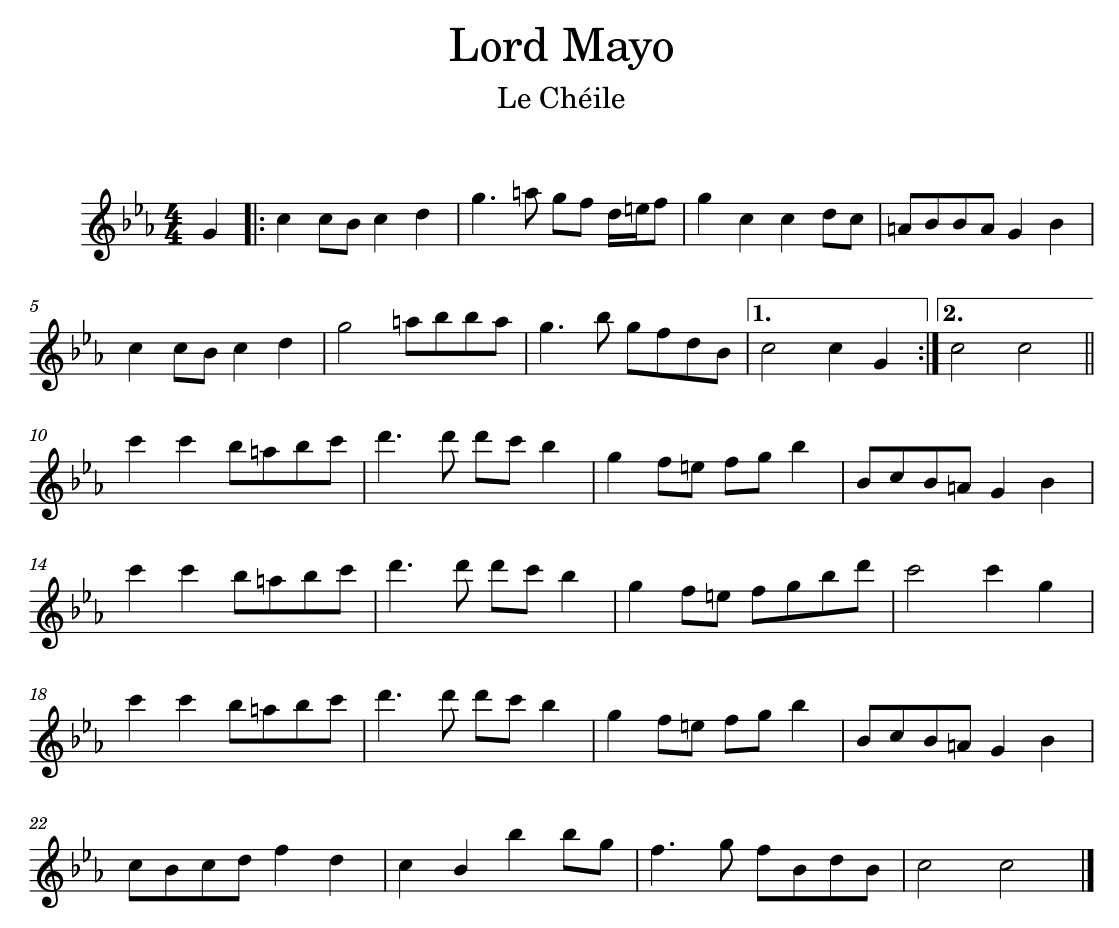
The earliest audio recording of the tune was by James McFadden, recorded on a wax cylinder in the early 1900s. [4] In 1975, London-based band Le Chéile released their album Lord Mayo, opening with P. J. Crotty, Kevin Boyle, and Raymond Roland playing the title tune. Despite the new key of C mixolydian and noticeable melodic variations, early versions of the tune are still recognisable. This version is closely related to those collected in London by MacDowell in terms of melodic contour and rhythmic patterns.
The earliest audio recording of the tune was by James McFadden, recorded on a wax cylinder in the early 1900s. [5] In 1975, London-based band Le Chéile released their album Lord Mayo, opening with P. J. Crotty, Kevin Boyle, and Raymond Roland playing the title tune. Despite the new key of C mixolydian and noticeable melodic variations, early versions of the tune are still recognisable. This version is closely related to those collected in London by MacDowell in terms of melodic contour and rhythmic patterns.


References
[1] Edward Bunting, The Ancient Music of Ireland: The Bunting Collections, facsimile edition (Dublin: Waltons’ Piano and Musical Instrument Galleries, 1969), p. 21.
[2] A Collection of the Most Celebrated Irish Tunes: Proper for the Violin, German Flute or Hautboy: Dublin 1724, John and William Neal, 2nd facsim. ed. by Nicholas Carolan (Dublin: Irish Traditional Music Archive, 2010), p. 100.
[3] The Most Celebrated Irish Tunes, ed. by Carolan, p. 1.
[4] See [The Kildare fancy ; Lord Mayo] [sound recording] / [James McFadden ; James Early], CID: 25657 <https://itmacatalogues.ie/Portal/Default/en-GB/RecordView/Index/25657> [accessed 18 April 2026].
Recordings of Aoife Sheridan performing were recorded in ITMA’s studio by Iarlaith Mac Gabhann. The blog post was uploaded by Heather Wallace.
Bibliography
Bunting, Edward, The Ancient Music of Ireland: The Bunting Collections, facsimile edition (Dublin: Waltons’ Piano and Musical Instrument Galleries, 1969)
Carolan, Nicholas and Caitlín Uí Éigeartaigh (eds), The Forde Collection: Irish Traditional Music from the William Forde Manuscripts (Dublin: Irish Traditional Music Archive, 2021)
Carolan, Nicholas and Caitlín Uí Éigeartaigh (eds), The Pigot Collection: Irish Traditional Music from the John Edward Pigot Manuscripts (Dublin: Irish Traditional Music Archive, 2024)
Carolan, Nicholas, ed., A Collection of the Most Celebrated Irish Tunes: Proper for the Violin, German Flute or Hautboy: Dublin 1724, John and William Neal, 2nd facsim. (Dublin: Irish Traditional Music Archive, 2010)
Irish Traditional Music Archive, ‘James Goodman Manuscripts / TCD MS 3194’, Volume 1 <https://manuscripts.itma.ie/goodman/volume-one/> [accessed 16 April 2026]
Joyce, Patrick Weston, Irish Music and Song: A Collection of Songs in the Irish Language, Set to Music (Dublin: Society for the Preservation of the Irish Language, 1901)
Kenedy, Patrick John, The Universal Irish Song Book: A Complete Collection of the Songs and Ballads of Ireland (New York: P. J. Kenedy, 1884)
Le Chéile, ‘Lord Mayo / The Green Groves of Erin’, on Lord Mayo (Standfast Records, 1975)
O’Brien, Paddy, ‘Lord Mayo, harp piece’, on The Paddy O’Brien tune collection : volume three : harp tunes 1-43. Disc 9 (Paddy O’Brien Tune Collection Project, 2013)
O’Brien, Paddy, ‘Lord Mayo, slow air’, on The Paddy O’Brien tune collection : volume three : hop jigs 1-16 : slip jigs 1-29 : slow airs 1-13. Disc 5 (Paddy O’Brien Tune Collection Project, 2013)
O’Farrell’s Pocket Companion for the Irish or Union Pipes, Volume 2 (London: Goulding & Company, 1806)
O’Sullivan, Donal, Carolan: The Life Times and Music of an Irish Harper, 2nd edn (Cork: Ossian Publications, 2001)
Roche, Frank, The Roche Collection of Traditional Irish Music (Cork: Ossian Publications, 1982)
Shields, Hugh and Lisa Shields (eds), Tunes of the Munster Pipers: Irish Traditional Music from the James Goodman Manuscripts, 2 (Dublin: Irish Traditional Music Archive, 2013)
Walker, Joseph Cooper, Historical Memoirs of the Irish Bards (Dublin: L. White, 1786)