
The Irish Traditional Music Archive (ITMA) is committed to providing free, universal access to the rich cultural tradition of Irish music, song and dance. If you’re able, we’d love for you to consider a donation. Any level of support will help us preserve and grow this tradition for future generations.
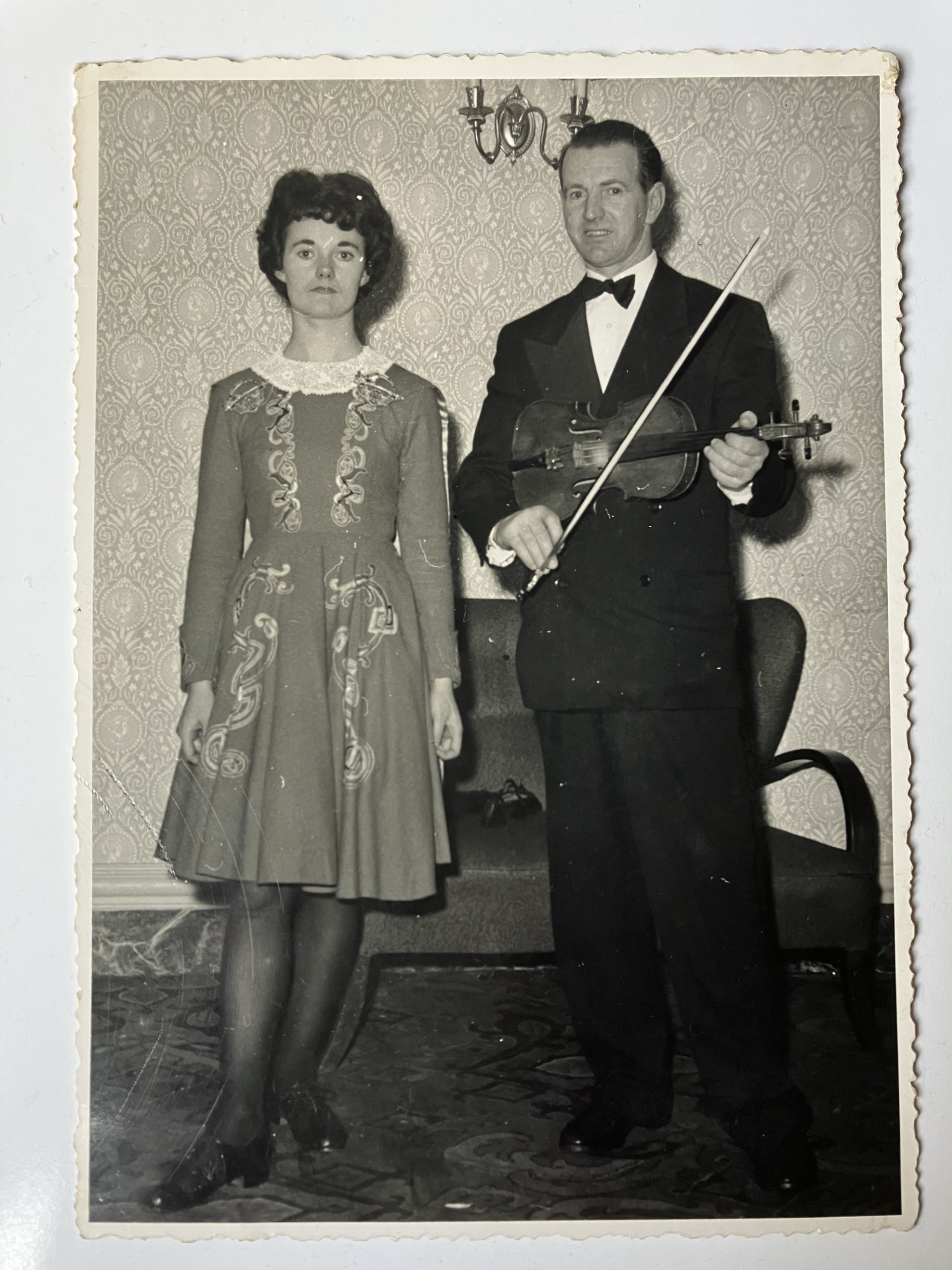
Jimmy Power was a remarkable musician/ fiddle player, and one of the architects of a golden period of music-making in London, who had a very interesting musical lineage through his connections with the Sligo fiddle player Michael Gorman and Waterford piper Liam Walsh.
Michael Gorman, generally regarded as the most inspirational and influential figure in London Irish music history, had in turn been taught by Jamesie Gannon — one of Michael Coleman’s teachers at the turn of the 19th/20th century. Gorman’s influence on the great players of the following generation — Bobby Casey, Máirtín Byrnes and Willie Clancy — was especially present in his star student John Vesey (who was taught by Gorman in Ireland as a child) and Jimmy Power, who met him in the late 1940s in London.
Perhaps contributing to their closeness was the fact that Gorman and Jimmy Power had a shared Scottish connection. Gorman had been born on the outskirts of Glasgow in 1895, and Jimmy Power had spent the years 1942 to 1947 there, during which period he married and his son Tom was born.
In London, Jimmy Power made weekly visits to Michael Gorman’s flat to learn versions of tunes and go over intricate bowings. Jimmy Power was himself in turn to become an influential musician encouraging and inspiring celebrated fiddle players Danny Meehan and Brian Rooney amongst others.
Jimmy Power’s residencies at various pubs, in particular the Favourite pub in Holloway Road, made them a meeting place and focal point for some of the best musicians and music making. This also provided an opportunity and platform for younger musicians to hear and play with some of the great masters.
You can listen in full to track 13 from the CD below.