

The Irish Traditional Music Archive (ITMA) is committed to providing free, universal access to the rich cultural tradition of Irish music, song and dance. If you’re able, we’d love for you to consider a donation. Any level of support will help us preserve and grow this tradition for future generations.
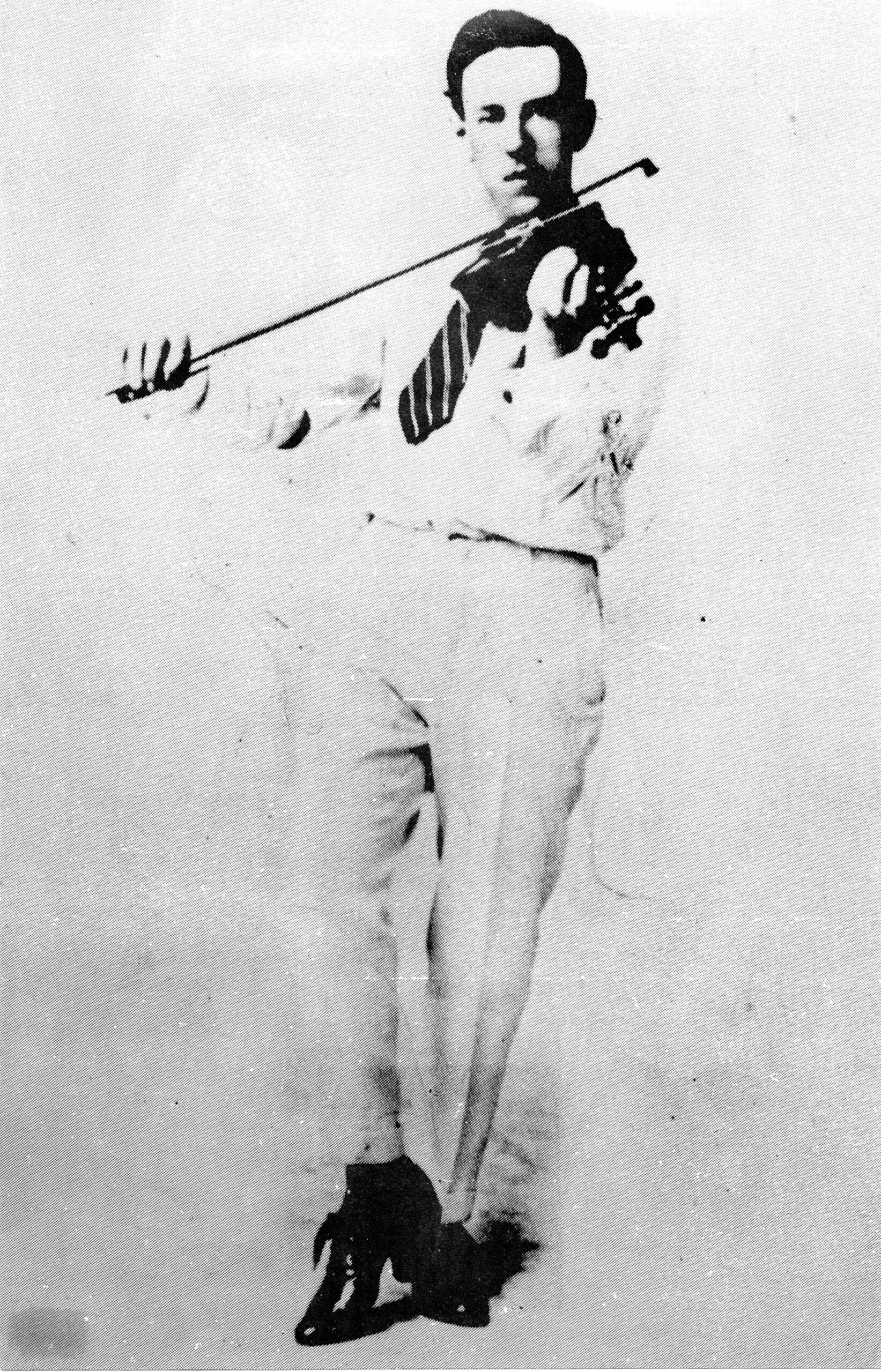
Michael Coleman (1891-1945) was a fiddle player born near Gurteen in County Sligo, in an area renowned for producing many of the leading Irish traditional musicians of the late 18th and early 19th centuries. Coleman emigrated to New York in 1914 and began his recording career in 1921. He is widely regarded as the most influential musician of his generation.
I have been listening to the recordings of Michael Coleman since I was a small child. My father, the Leitrim fiddler Ben Lennon (1928-2020), was obsessed with Coleman and in particular working out his bowing techniques and phrasing. It was a lifelong passion, both for him and his brother Charlie (1938-2024), another fiddler and composer, and has become a lifelong passion for me as well.
The idea of being able to remove the piano backing on the recordings of Michael Coleman has been around for a very long time and was a topic of discussion over the years with Ben and Charlie, and with other Coleman fanatics, including my brothers Brian and Maurice, Fr. Seamus Quinn, John Carty and James Carty — all fine fiddlers in their own right.
For us, and many followers/devotees of Coleman’s, the listening experience could, on some recordings, be unsatisfactory, particularly where the piano was either too loud, out of sync (with the fiddle), in the wrong key or, in the worst cases, a combination of all of the above!
I first became aware that technology existed that allowed different instruments to be separated on old recordings when The Beatles released a song in 2022/2023 which extracted John Lennon’s (no relation!) vocal from a demo recording and allowed recording engineers at Abbey Road Studios in London to mix the song with new instruments and a new arrangement.
I contacted Abbey Road Studios in 2023 to investigate the possibility of using their technology on some of Coleman’s most badly effected recordings. When I didn’t receive a reply, I decided to wait until the technology became more freely available. I didn’t have to wait long.
Fast forward to summer 2025 and a text from James Carty alerting me to a podcast featuring a young musician and student from the US, the aptly named Colman Connolly. I knew of Colman having seen him provide excellent piano accompaniment to various musicians online. As part of a college thesis Colman had worked on a project to use a variety of different AI tools to extract the piano from some of Coleman’s recordings, before adding his own piano accompaniment.
I decided to investigate what AI tools were available for myself (with some guidance via email from Colman). I tried a variety of different AI tools on a variety of different recordings before landing on a particular mix of settings that gave the desired result.
For me, hearing Coleman without piano is like hearing him for the first time. Having spent a lifetime studying and listening to his recordings it was extraordinary.
The ability of the AI tools to extract the piano without significant loss of tone from the fiddle is remarkable, and well beyond my technical competence to properly explain…
It is now possible to hear not only all the variations that he employs but it also allows the listener to hear individual bow strokes in a way that was simply not possible before.
I had convinced myself that I was mentally screening out the piano after years of listening… however, when I hear these recordings now without piano, I can see that I was fooling myself.
Over the years I have heard many young musicians say that they couldn’t listen to the old 78rpm recordings, with poor piano being given as one of the main reasons. Hopefully with the help of AI, young musicians will revisit Coleman. It is, in my opinion, a very rewarding experience.
There are believed to be a total of 107 recordings of Michael Coleman in existence today – the majority of these were commercial recordings and I have concentrated my efforts over the last 6 months on those recordings.
On this first set of remixes I have chosen recordings from across the span of Coleman’s recording career, which lasted from 1921 to 1936.
During that time (1921-1936), recording technology advanced considerably. The early recordings (up to 1925) were in the pre-electric era and, as a result, were quite poor quality. By 1936, the final year of Coleman’s commercial recording career, the technology had markedly improved.
I have also included the original recording with piano so that the listener can compare and contrast.
These recordings are further proof, if it were needed that Coleman was a musician of extraordinary talent. Hopefully these edited recordings will provide listeners with a better insight and understanding of why he was so influential.
Finally, it would be remiss of me not to thank Colman Connolly for his advice. As they say in the West of Ireland the apple doesn’t fall far from the tree, Colman is the son of another excellent fiddler and accordionist, Damien Connolly, who in turn is a nephew of Séamus Connolly, a well-known and widely acknowledged master fiddler from Clare and based in the US for many years.
Séamus was a great friend of my father and uncle and has played a major role in unearthing rare private recordings of Coleman through his work with Boston College. Séamus also shared the same obsession with Coleman’s bowing that intrigued Ben and Charlie. For many years prior to Ben’s passing in 2020, Séamus would pick up the phone on Christmas Day and, after social niceties had been observed, would get down to solving the mystery of Coleman’s bowing and up-bow and down-bow trebles! My father always looked forward to those calls.
I would also like to thank Liam O’Connor, Andrew Caden, Ronan Galvin and Dr. Adam Girard from ITMA, for their continued encouragement and support.