
The Irish Traditional Music Archive (ITMA) is committed to providing free, universal access to the rich cultural tradition of Irish music, song and dance. If you’re able, we’d love for you to consider a donation. Any level of support will help us preserve and grow this tradition for future generations.
The likes of Michael Coleman, James Morrison, Paddy Killoran, John McKenna, Peter Conlon, John J. Kimmel, Frank Quinn, and the Flanagan Brothers produced hundreds of records combined between their illustrious musical careers in America. However, the vast majority of musicians who recorded in the “78 era” recorded only a small number of discs. Andrew Caden has curated a playlist with recordings of such musicians, which have become difficult to find and listen to due to their rarity. As part of this effort, seven 78 rpm shellac discs have been newly digitised using ITMA’s state-of-the-art equipment, featuring musicians like uilleann piper Martin Beirne, fiddle players Tommy Cawley, James Claffey, John Joe Gardiner and Kathleen Harrington, flute players Patrick Doran and John Griffin, and accordion player William McElligott.
It is acknowledged that there is only one female musician featured on this playlist. Very few women were commercially recorded on 78 rpm discs, and work is ongoing to highlight female musicians like Redie Johnston, The McNulty’s, and Margaret McNiff-Locke in ITMA’s From the Bridge exhibition, as well as OldTime Records’ release of If There Weren’t Any Women in the World.
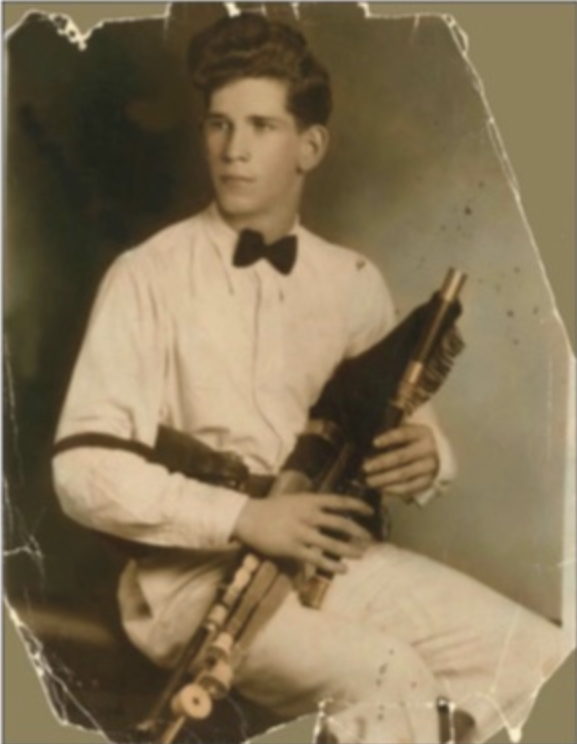
Born in Co. Roscommon, Martin Beirne was brought on a ship to the United States as an infant in 1910 and was raised in New Jersey. Not much is known about Beirne’s upbringing, but he is thought to have learned the uilleann pipes under Michael Carney. He played regularly on the radio, was a member of the County Roscommon Boys Irish orchestra and later became the leader of the Irish Blackbirds Orchestra.
Beirne recorded commercially in 1936 for Columbia and in 1938 for Vocalion, mostly with the Irish Blackbirds Orchestra. The side digitised for this playlist comes from a Regal Zonophone disc (IZ 639), which is a re-issue of one of his Columbia sides (33358-F). It is significant that Beirne plays the pipes solo, without the rest of band, something he only did on a few occaisions. It is also unusual in that it features piano accompaniment, which while common in during the 78rpm era, is almost never associated with the uilleann pipes. The reel he plays is titled “The Grand Spy”. It is likely that the recording made an impression on the famous fiddle player Michael Coleman, who played a strikingly similar version to Beirne’s on two of the sides he recorded for the World Broadcasting Company in 1944 and titled the tune using the same unique spelling as Beirne.
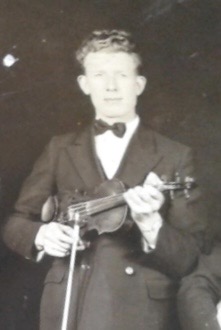
Born in Doocastle, Co. Mayo, Tommy Cawley grew up in Chafpool, Co. Sligo, learning the fiddle from his father Richard. Tommy emigrated to the United States in 1926, landing in New York, before moving farther west to Chicago. During his time in Chicago, he lived with John Neary, who was the host of many house sessions during the time. Cawley made his first commercial recordings for Columbia, just a few months after arriving in America, as part of a trio with Patrick Doran (flute) and Francis Malone (piano). There is little information on the lives of Patrick Doran and Francis Malone, but Doran recorded six sides for Gennett prior to the trio with Cawley and Malone. Cawley later recorded 2 more discs for Columbia in 1929 with fellow fiddle player Francis Cashin.
Through the 1930s, Cawley was based in New York, where he played in various band lineups and connected with musicians from his home area like Michael Coleman and James ‘Lad’ O’Beirne. In 1937, Cawley partnered with Michael Coleman in a music teaching business, but it did not last long. He continued to teach privately in the years after this and was later a pallbearer in Michael Coleman’s funeral. At the age of 35, Cawley was drafted to serve the US military in WWII, though the details regarding the completion of any service are unclear. Cawley tragically passed away before his time due to a brief illness in 1945, and his loss was greatly mourned by the Irish music community of the time. A more in-depth account of Tommy Cawley’s life is covered in Cry of a People Gone, a book on Irish musicians in Chicago from 1920 to 2000, written by Richie Piggot.
The A side of this disc (Columbia 33144-F) is a rarely heard tune titled “The Drumshanbo jig”. There is a reel on the B side titled “Miss Forkan’s fancy”, which is more commonly known as “The steampacket”. The version they play features unusual turns at the endings of both parts. It is acknowledged that there is a significant amount of noise interference present for these recordings, which is due to the condition of the discs used to do the digital transfers.
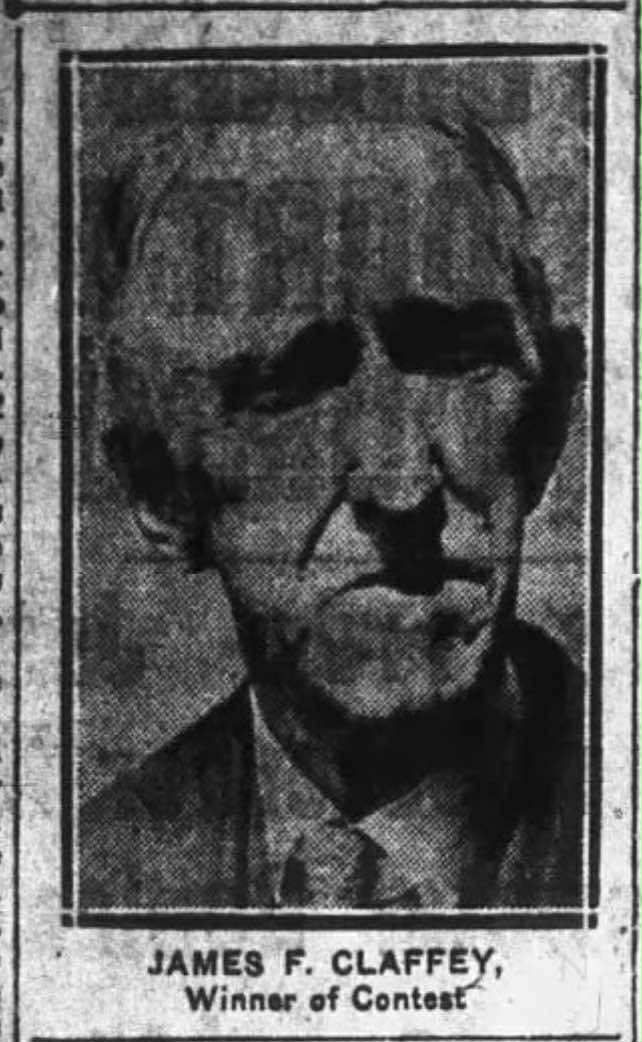
James Claffey was born in Massachusetts to an American father and an Irish mother. He made his living primarily from teaching music out of his house and working on pianos. Claffey also toured across the United States playing the violin on the vaudeville circuit, and is said to have played with the Boston Symphony Orchestra for some time. He won the World’s Old Fiddler’s Contest hosted in Lewiston, Maine 1926, competing against 107 other fiddlers, including the likes of James Scott Skinner. He was awarded a silver loving cup and 1,000 dollars for winning (worth more than 15,000 euro in today’s currency).
In the following years, Claffey became one of Columbia’s “Featured Recording Stars”, making commercial recordings for them from 1927 to 1929. Some of his discs were classified as Scottish and were issued for the Scottish market; however, many of the tunes he played were still Irish, and Spottswood included them in his discography of Irish 78 rpm records.
Two of Claffey’s discs from 1928 were digitised for the playlist. The first one (Columbia 37008-F) has the well-known Scottish song “Blue bells of Scotland” on side A, written by Dora Jordan in 1801. Claffey’s version, adapted for the fiddle, is more spirited and does not use the vocal lyrics. Side B has a selection of highlands with phonetic spelling used for some of the titles, “Roy’s wife”, “Who wadna fecht for Charlie”, and “Saw we Johnny Comin’”.
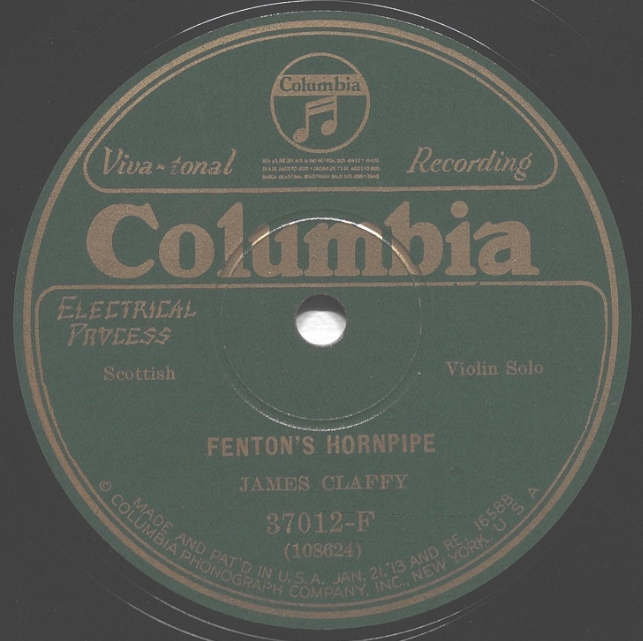
Claffey plays two hornpipes on the second disc (Columbia 37012-F). “Fenton’s hornpipe” on side A is related to the common tune “Buck on the Mountain”, with Claffey’s version showing off a run up to the high D at the ends of each part. “Roger’s hornpipe” on side B is a seldom heard tune, which Claffey plays in the key of B-flat.
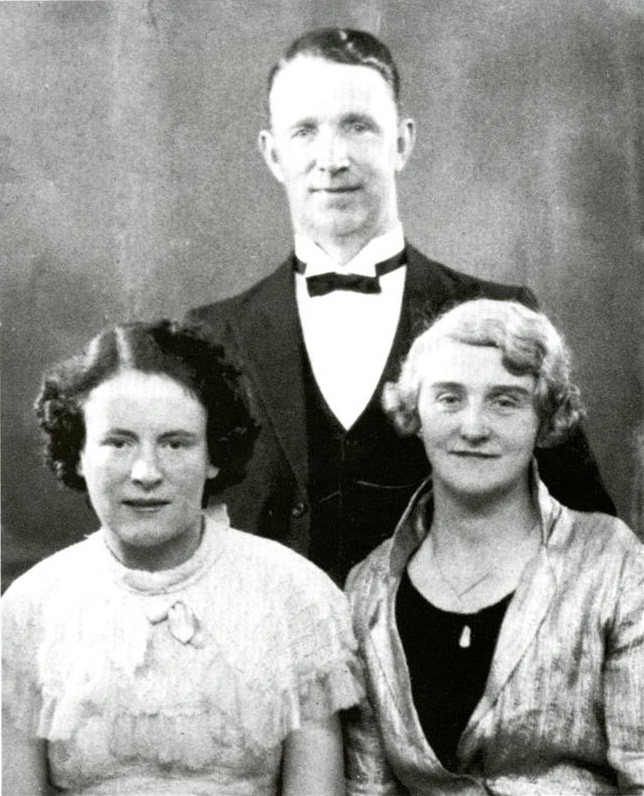
John Joe Gardiner (1892-1979) and Mrs Kathleen Harrington née Gardiner (1897-1984) were born to a musical family in Corhober, Ballymote, Co. Sligo. They grew up playing alongside Michael Coleman, James Morrison, and Paddy Killoran, musicians who all ended up emigrating to the United States and having successful recording careers. Neither John Joe or Kathleen followed suit to the United States, but they were given a rare opportunity to record commercially in Dublin in 1938. They made two discs as a trio with pianist Moya Acheson. One was under the name “The Gardiner Trio”, while the other was called “The Harrington Trio”.
John Joe and Kathleen also recorded two solo sides each, and ITMA is excited to make newly digitised transfers of these rare recordings available online. This was made possible thanks to copies of these records in especially good condition, as well as recent upgrades to ITMA’s digitisation equipment. Mick O’Connor covers more details on Mrs Harrington’s life in an ITMA blog post, which can be found here, as well as in his book In Safe Hands, where there are extensive accounts of both the Gardiner siblings’ lives.
The A side of John Joe’s disc (His Master’s Voice I.M.532) is a set of hornpipes beginning with “The cuckoo”. The use of a high C-sharp in the second part associates his version of this tune with the Sligo region. The second hornpipe, titled “The sweeps”, is also known as “Jim Coleman’s”, and was a lifelong favourite of Gardiner’s. The set of reels on the B side of Gardiner’s disc starts with “The mountain top” and is followed by “Lord Wellington’s”, a two-part version of “The bunch of keys”.
Kathleen Harrington plays a set of reels on both sides of her disc (His Master’s Voice I.M.537). On the A side, she plays the common reels “Farrell Gara” and “The scholar”. The B side begins with the now iconic “Tarbolton” reel, which was derived from the recording made by Michael Coleman just four years earlier. It also features the same misspelling of the tune as on the Coleman disc, coming out as “Tar Bolton”. The second tune in the set is a version of “The heather breeze”, which is similar to the one made famous by Paddy Killoran four years prior again.
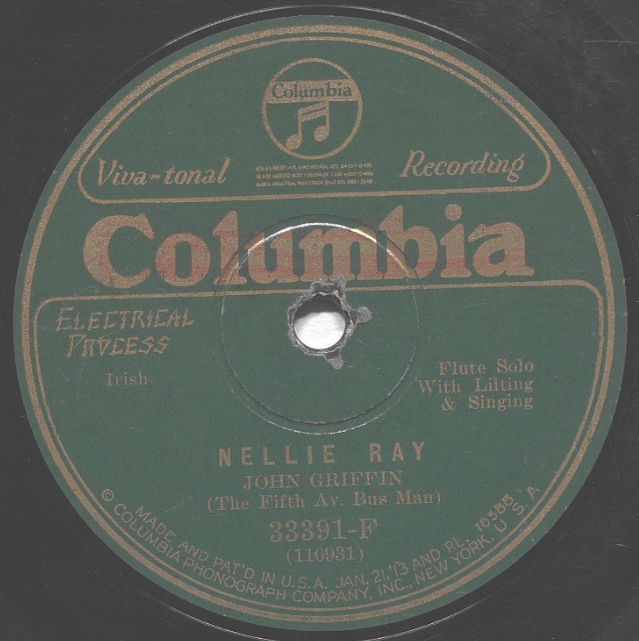
Known as “The 5th Avenue Busman”, John Griffin was originally from Cloontowart, Lisacul, Co. Roscommon, and he emigrated to New York in 1917. Griffin first recorded 4 discs for Gennett from 1924 to 1925, and then an additional 3 for Victor from 1926 to 1927. The bulk of his career was with Columbia which comprised of 28 discs recorded from 1927 to 1932. He finished his recording career by joining Martin Beirne’s Irish Blackbirds Orchestra for a disc in 1936, sneaking in a solo record (33559-F) under the pseudonym Jack Feeney on that same day. Griffin was famous for singing or lilting tunes and then playing their medleys on the flute, which he did at a very high standard.
Of the musicians included on this playlist, Griffin had the most prolific recording career by far. Despite this, he is still far less known today than many of his musical contemporaries.
This record (Columbia 33391-F) was chosen to be digitised because it did not appear to be easily accessible online. Side A of this disc is an affectionate song called “Nellie Ray”, with a rhythm resembling a Sligo polka. The second side is a mischievous song called “Meself and Martin Tracey”.
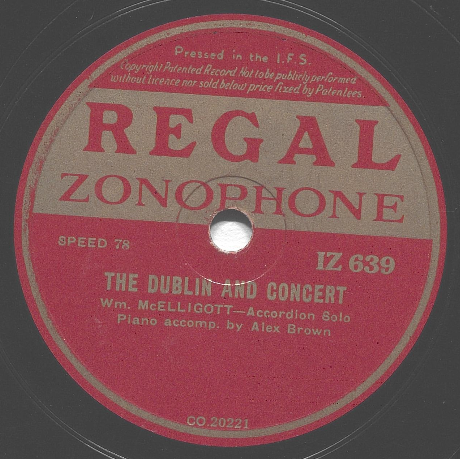
William McElligott was an accordion player originally from Newcastle, Co. Limerick. He emigrated to the United States in 1928 and settled in Westchester, New York, where he made a living as a maintenance man. McElligott was a highly respected musician, and was often the box player of choice for top musicians of the time like Paddy Killoran and James ‘Lad’ O’Beirne, who is said to have hand-made a custom accordion for him. He began recording commercially doing three sides for Decca in 1934, with two done solo and one as a duet with fiddle player Paddy Sweeney. In 1936, he recorded two solo sides for Columbia and joined Martin Beirne’s Irish Blackbirds Orchestra for another two sides during the same recording session. While never explicitly credited, it is also thought that McElligott played on some of Paddy Killoran’s band’s records.
McElligott’s latest commercial recordings were for Decca in 1938, where he recorded 12 sides of vocal music, where he accompanies himself on the accordion. McElligott was drafted into the United States military to serve in WWII in 1940, but the details regarding the length and location of his duties are unclear. He continued to live in New York after returning from the war.
This recording is the B side of the Regal Zonophone (IZ 639) disc. It is one of the solo tracks McElligott recorded in 1936 is a hornpipe medley titled “The Dublin and concert”. The first tune in the set is an accordion classic known as “The showman’s fancy”, while the second tune is the not often heard or easily played, “The concert hornpipe”.
ITMA recognizes that some of these tracks may have been used in recent re-issues of 78 rpm works.